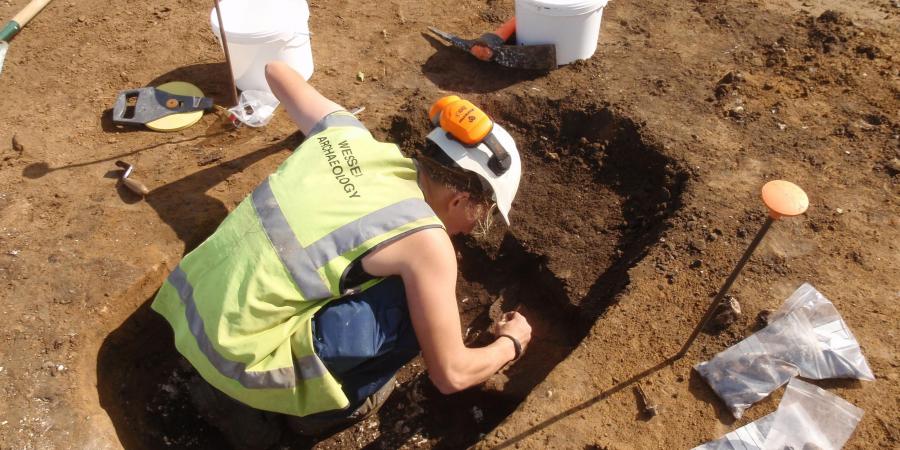
In 2008–10 excavations undertaken on land formerly occupied by Queen Mary’s Hospital, Carshalton, in the London Borough of Sutton, in advance of redevelopment, revealed a complex Iron Age and Romano-British site. The site lies on the north-facing dip slope of the North Downs overlooking the valley of the River Wandle, immediately outside the substantial scheduled Late Bronze Age ringwork (LO 163).
The excavations found very little evidence for Late Bronze Age activity, but by the Early/Middle Iron Age an open settlement had been established, represented by a single roundhouse with an adjacent square post-built granary-type structure, and several relatively shallow pits, some of which were for storage. A single neonate burial dated to this period. By the end of the Middle Iron Age part of the settlement area had been bounded by small enclosure ditches, the larger D-shaped enclosure, with a west-facing entrance, to the west, and a smaller sub-square enclosure to the east, and with a possible trackway running along their northern sides.
The enclosures were modified and enlarged during the Late Iron Age and early Romano-British period, but their overall arrangement remained largely the same during these later periods. No later structures were identified however, and apart from a small number of further neonate burials, almost all the features were pits. These were of varying size and shape, but many of them were of classic storage pit form, including a few bell-shaped examples.
A range of artefactual and environmental remains indicates activities relating to farming, settlement, craft/industry, and ritual/religion. The mixed farming economy involved the cultivation of wheat and barley on the surrounding Chalk downland, and the keeping of livestock (sheep, cattle, pig and goat). Dog, cat, horse and domestic fowl were also represented in the bone assemblages, along with a few wild species (deer, fox, hare and corvids – raven and crow/rook). On-site craft/industrial activities included the manufacture of yarns and probably also textiles, and, by the early Romano-British period, metalworking.
The pits of all periods contained very variable deposits, although a relatively common feature in the Late Iron Age and early Romano-British period was the presence of groups of articulated animal bone, comprising partial or complete animals, sometimes in large numbers. A single fill of one early Romano-British pit contained the butchered partial carcasses of 25–30 animals, predominantly sheep/goat but also including two dogs, a perinatal horse, two domestic fowl and a raven. Also of note were several dog burials which showed particular care in the arrangements in the animals, presumably for symbolic reasons, occasionally occurring with pots. In addition, one small subrectangular (almost grave-shaped) Late Iron Age pit contained a careful selection of broken or incomplete objects, including large parts of a single pottery vessel, a decorated iron spearhead, a nave hoop (from a wheel axle), and lumps of tar with impressions of twisted vegetable fibres.
While the pits also contained dumps of domestic waste and soil, it is likely that many of these below-ground contexts, used initially for the storage of grain, and therefore central to the community’s survival and prosperity, had powerful symbolic associations, relating to ideas of life and death, decay, regeneration and fertility, which may have been transferrable to the animal remains. It seems likely that many of the acts of deposition involved elements of ritualised and religious sacrifice designed to appease and show gratitude to the local deities.
You can read more about these discoveries by purchasing our publication Queen Mary’s Hospital Carshalton. An Iron Age and early Romano-British Settlement by Andrew B. Powell