Founder of Royal Exchange linked to 16th century shipwreck
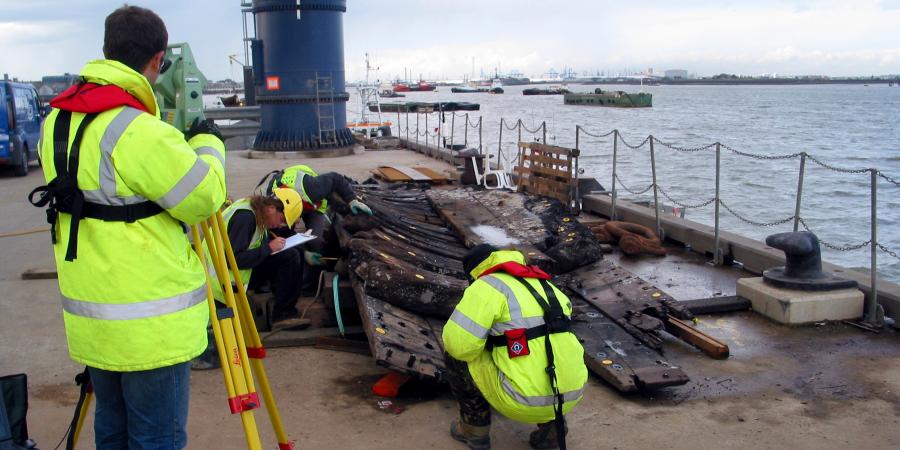
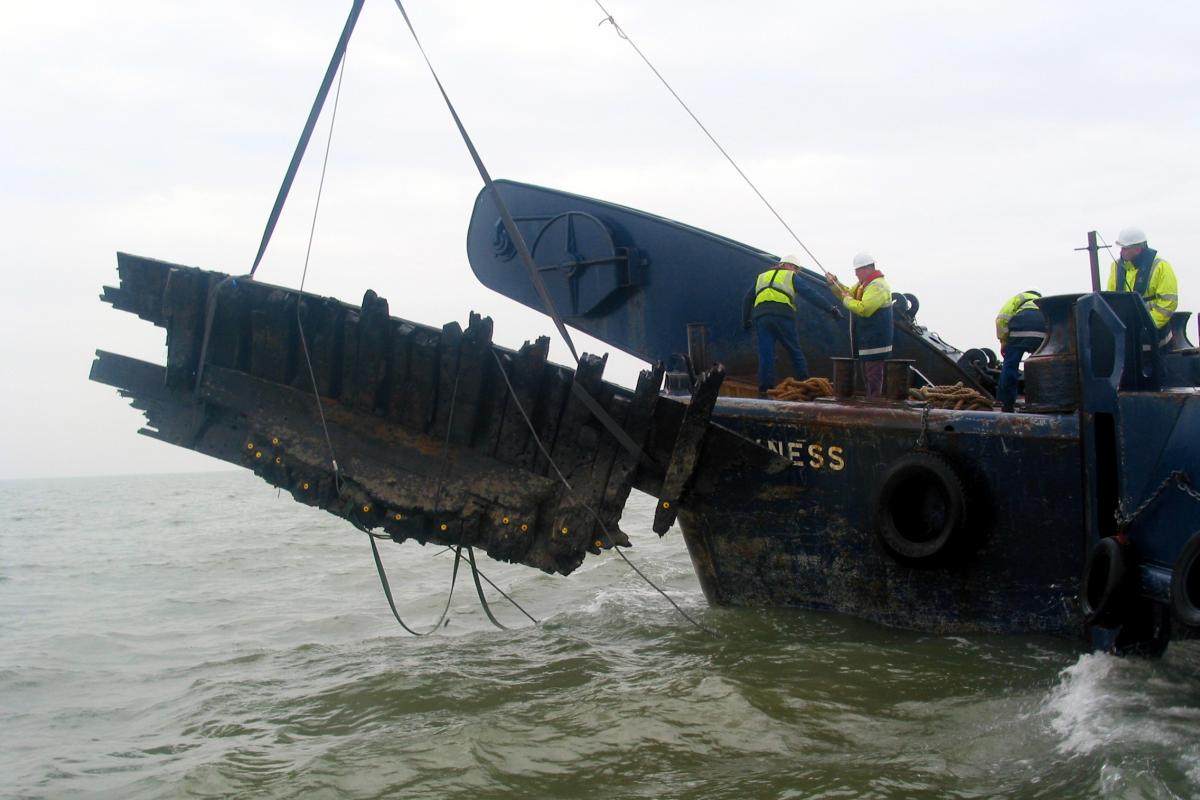
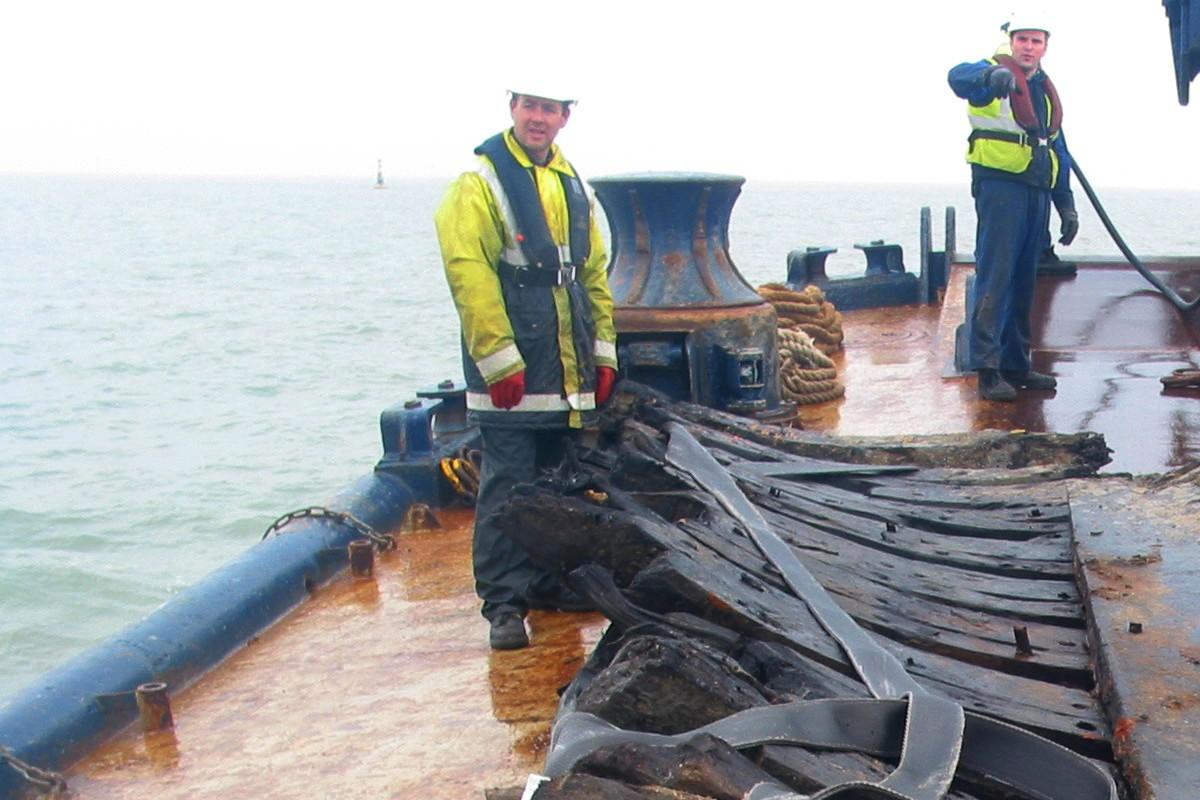
Over the summer of 2004, the Port of London Authority worked with Wessex Archaeology to excavate and recover the bow and part of the side of a late 16th century merchant ship. The shipwreck was first located in April 2003 when the Port of London Authority was undertaking survey work in advance of dredging to deepen the Princes Channel to allow safe passage for the increasingly large ships using the Port.
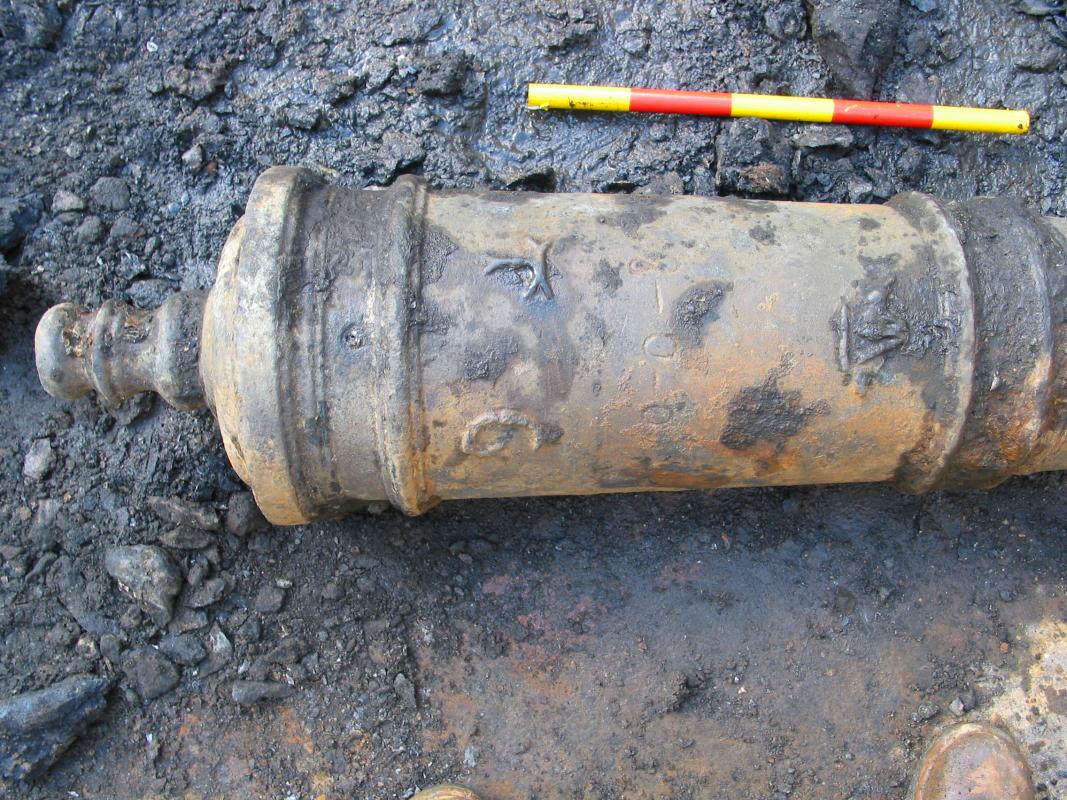
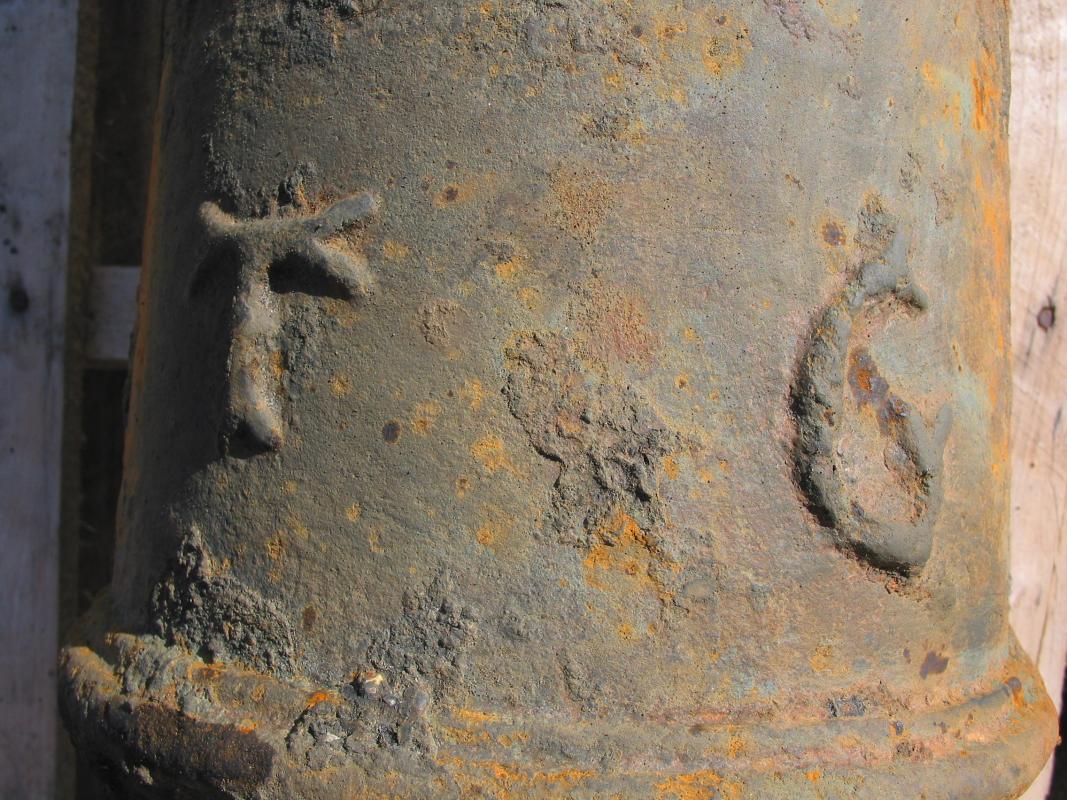
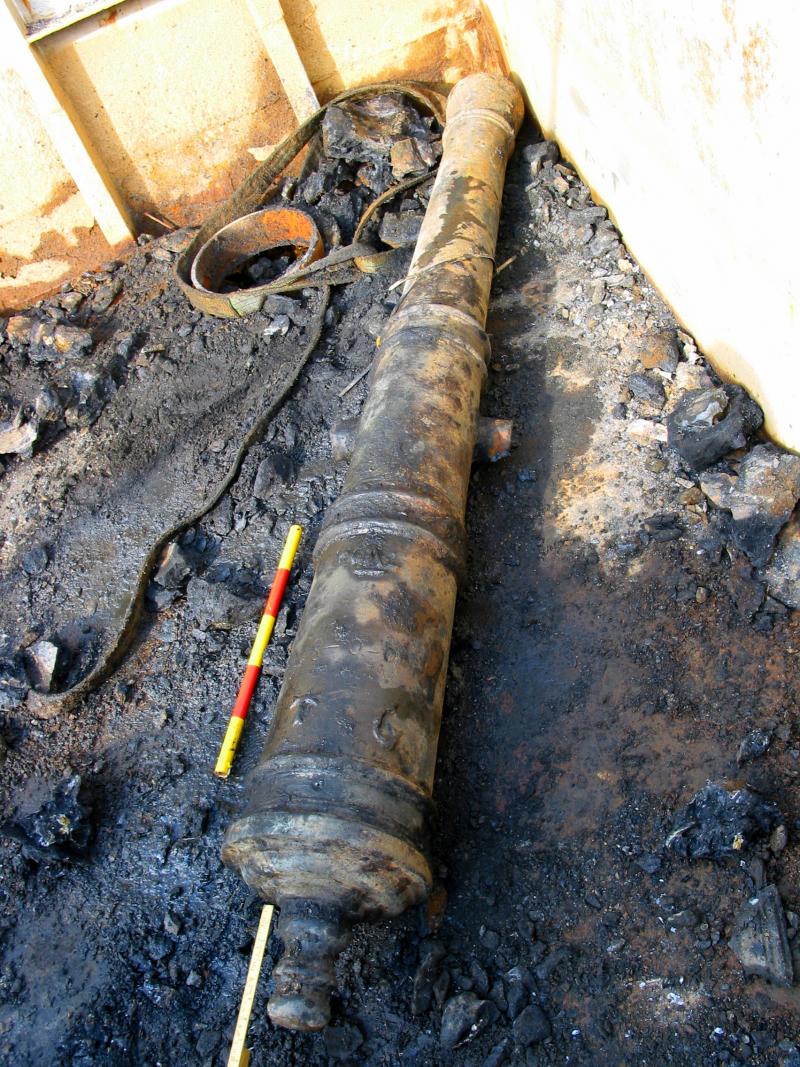
The ship’s timbers have been dated to 1574, and amongst the artefacts recovered is a cannon that has the maker’s marks ‘T G’. The Royal Armouries, Fort Nelson, have identified those marks as belonging to Sir Thomas Gresham, merchant, skilled financier and Royal Agent to Elizabeth I. He was the principal figure in the founding of the Royal Exchange in 1565.
Between 1570 and 1579, Sir Thomas Gresham had interests into two iron-founding furnaces in the Weald of Kent, and in 1574 and 1578 he received licences to export cannons to Denmark. It is possible that the ship was transporting his guns with other metal products when it was lost in the Thames Estuary.
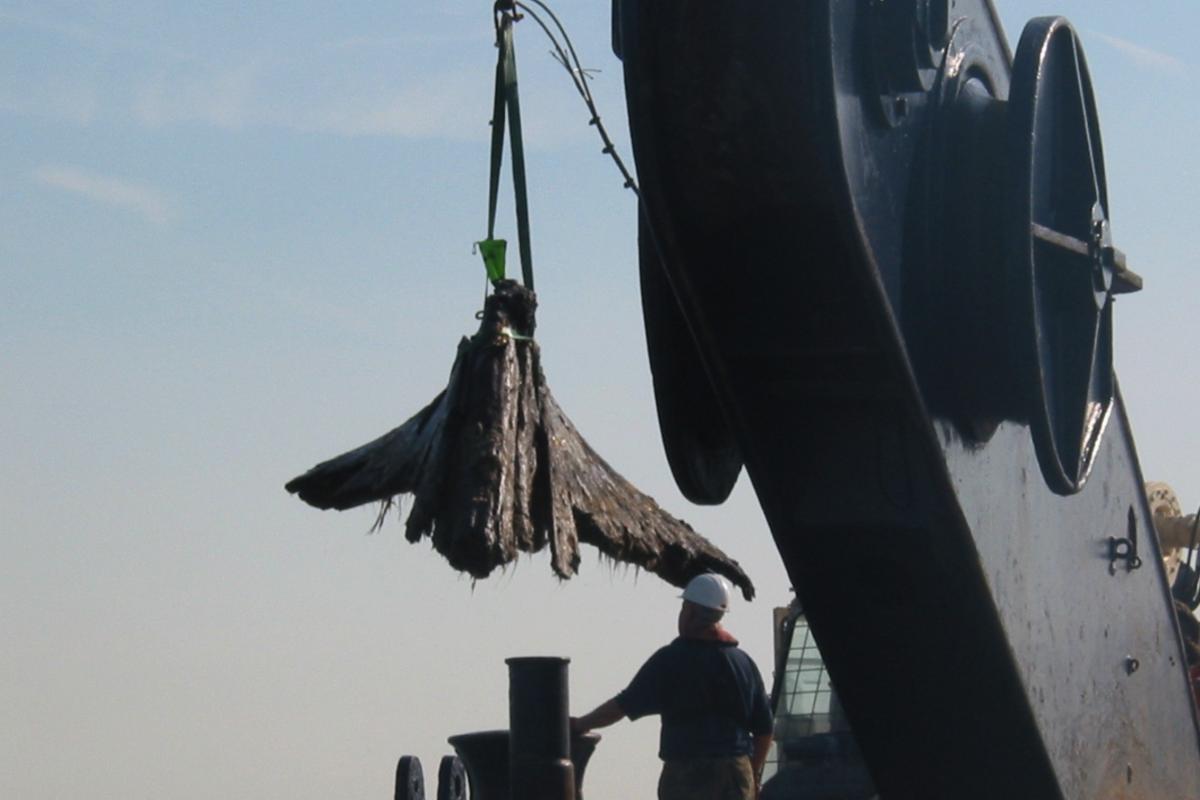
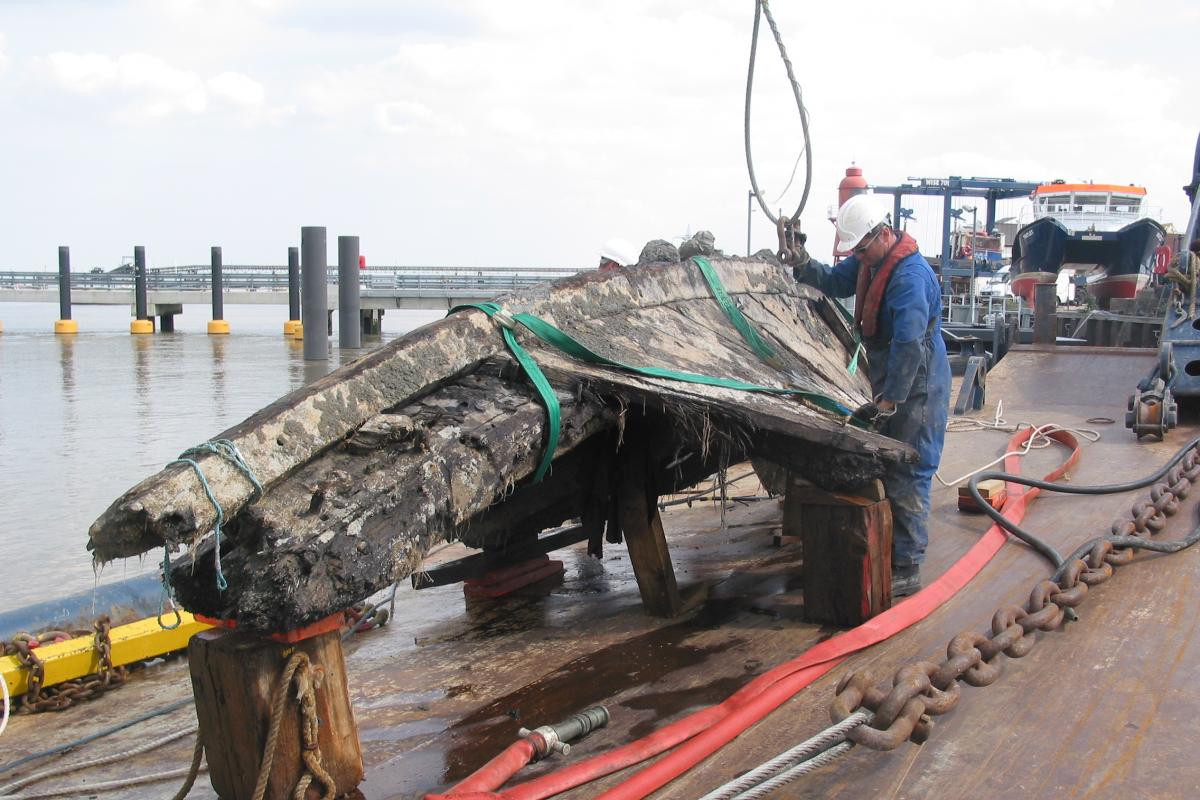
The artefacts recovered from the shipwreck includes three other cannons, wrought iron bars, lead and tin ingots, an anchor, and more personal items such as candlesticks and leather shoes. The collection of artefacts is small, but the ship’s timbers are providing a wealth of insights into Tudor shipbuilding.
The investigation of the wreck site progressed through a series of evaluation stages over 10 months before the decision was taken to proceed with the recovery. Detailed hydrographic survey was undertaken first to establish the extent of the site. PLA and Wessex Archaeology divers worked together to ground-truth the underwater imaging and determine the nature of the wreck. A variety of ship timbers and artefacts were recovered to try to establish the date and origin of the ship.
The ship’s timbers have found a new home in Horsea Lake, near Portsmouth, providing an underwater training site for maritime archaeologists under the auspices of the Nautical Archaeology Society.
Basic Facts
Apparent date of ship’s construction and origin:
The vessel is of carvel construction, and the remains on seabed consisted of one side of the vessel from amidships forward towards the bow. The vessel is built of oak from eastern England. Dendrochronology indicates date of construction shortly after 1574 AD.
Apparent function
Iron bars, tin and lead ingots are thought to be cargo, hence the wreck is considered to be that of an (armed) merchant vessel. Dimensions indicative of a large vessel (25-35m) capable of extensive voyages.
Ship's identity
Research into the wreck’s identity is continuing, but it is hoped that the cannon identified as being produced by Sir Thomas Gresham’s iron foundries may help to establish a link between this prominent Tudor businessman and the ship.
Artefacts recovered
Ferrous concretions, folded iron bars, ballast stones, lead strip, and lead pipe have been recovered, along with a fragment of Spanish olive jar. The cannons include a breech-loading wrought iron gun and three cast iron guns. A ship’s anchor with a wooden stock and broken fluke have also been recovered.
What is it?
The vessel has been identified as a late 16th century armed merchant vessel. Originally the vessel was possibly up 25-35m long (80-115ft long). The remains are part of the one side of the vessel - from amidships towards the bow up to the level of the first deck.
How was it found?
The wreck was first located in April 2003 by the PLA. During hydrographic survey, the wreck registered as a magnetic anomaly on the seabed. Over the summer months, further investigation and inspection by the PLA’s divers identified a section of wooden ship just visible above the seabed. Various items were recovered including a broken anchor, 2 cannons, and a quantity of ship’s timbers. Wessex Archaeology were asked to record the recovered items and timbers in the autumn of 2003.
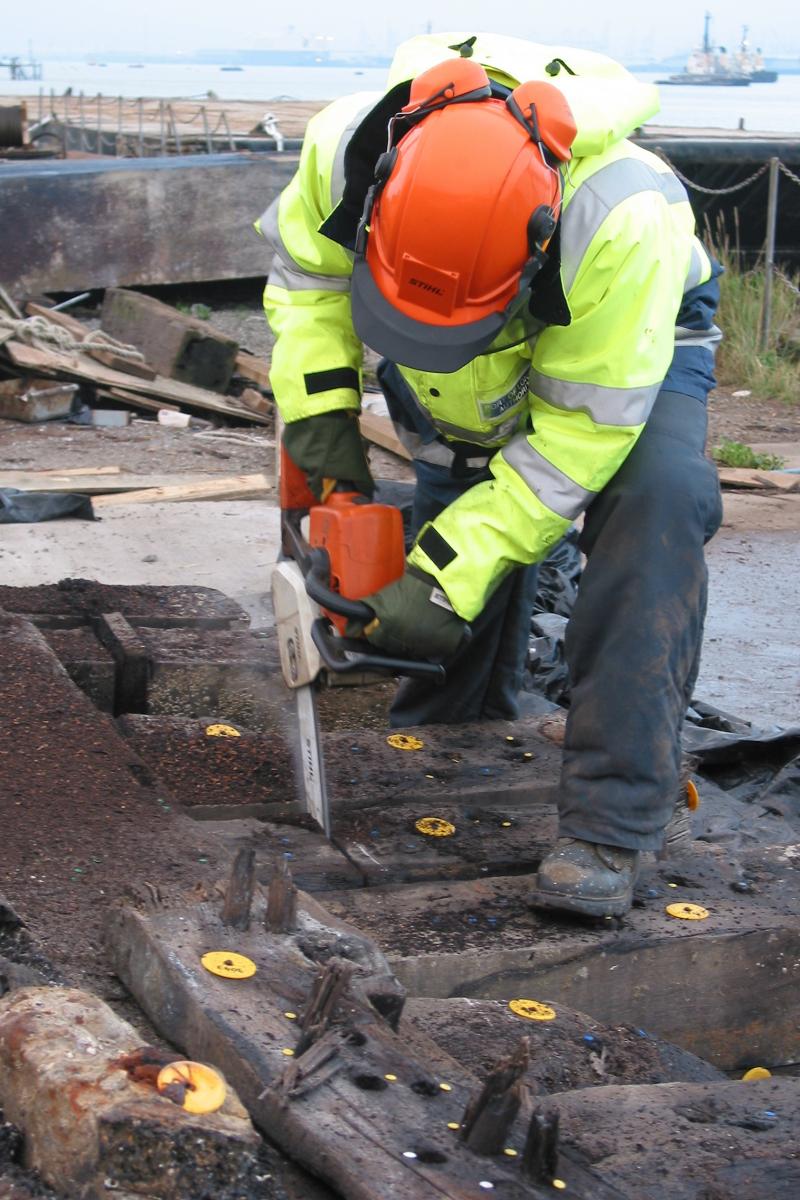
A rolling programme of evaluation was undertaken of the wreck. Sections of hull structure were recovered and recorded in November 2003 and January 2004. Dendrochronological dating and hydrographic survey were undertaken in May 2004. Excavation and recovery of the main wreck was begun in August 2004.
How old is it?
Dendrochronological dating is a scientific method of identifying where the timber used to construct the ship was grown and when it was felled using the pattern growth rings of the tree. Samples taken from the larger timbers recovered from the seabed have suggested a date of around 1574AD for the vessel’s construction, and with the source of timber being East Anglia or Essex.
Hence, we have a ship that is most likely English in origin, built during the reign of Queen Elizabeth I.
How was it lost?
The ship itself has not been identified as yet, but contemporary accounts of wrecks in the Thames Estuary reveal that is was a dangerous stretch of water.
Shifting sandbanks and swift currents were a large part of the problem. There were no sailing charts as we would use today, and a great reliance on local pilots or the crew’s own knowledge. There was no port authority controlling shipping movements and providing up to date information on safe navigation as the Port of London Authority does now. It is possible that this ship stranded on one of the estuary sandbanks, was damaged and foundered.
The wooden planking of the wreck shows that the vessel has undergone small repairs during its life. We only have parts of the ships hull from which to draw any conclusions. WA only very recently finished gathering information about repairs and possible hull weaknesses, and so analysis is far from complete.
What was it carrying?
The wreck included a quantity of cast-iron iron bars, which are thought to be part of the cargo.
Two of the cannons have the remains of ropes and a small fragment of gun carriage associated with them. This suggests they may have been part of the ship’s armament. The others may be part of the ship’s cargo.
Amongst the recovered items are several large concretions. Concretions are conglomerations of iron corrosion products, smaller artefacts from the wreck and debris from the seabed in one amorphous mass. X-ray examination can detect the contents of the concretions, and this is one of the techniques of archaeological examination that could be utilised to analyse the concretions further.
What was the link to Sir Thomas Gresham?
Sir Thomas Gresham (1518/9 – 1579) was a highly successful merchant and entrepreneur who served Henry VIII, Edward IV and Elizabeth I in a variety of roles chiefly concerned with finance. One of his many successes as Royal Agent in Antwerp was an ingenious way of raising the value of the pound sterling from 16 to 22 Flemish shillings to assist with the repayment of the Crown’s debts. Gresham also undertook diplomatic missions, such as ambassador to the Court of the Duchess of Parma. When Carols V placed a ban on the export of bullion from the Netherlands, Gresham adroitly moved into smuggling bullion disguised as cargoes of pepper and arms.
In 1564, he offered to build a currency exchange in London, if the Corporation of London and the Mercers Company would provide the site. The foundation stone for the first Exchange was laid in 1565 and the building completed in 1568. Elizabeth I visited the building in 1570 and thereafter it became known as the Royal Exchange.
The outbreak of war in the Low Countries compelled Gresham to leave Antwerp in 1567. His interest in the Weald iron industry is noted in 1570 when he was using the Mayfield Furnace, Sussex. He is named as the owner of the Mayfield furnace in 1574, the same year in which he was granted a licence to export guns to Denmark. Gresham leased a second furnace near Frant, Wadhurst, in 1574 and he was given a second licence to export armaments in 1578.
Bar iron is likely to have been another product of Sir Thomas Gresham’s furnaces. The bulk bar iron trade from the Weald was driven by large ironmongers based in London, with products being transported overland to the capital or by sea from the Port of Rye. The River Medway was also used as an export route, with Rochester being Gresham's usual port for exports. It is around this time (1560s) that Gillingham reach and the Medway became a recognised anchorage for the increasingly well-organised ‘Queen’s Navy’. Ship trades began to develop locally to support the fleet.
Throughout the 1570s, the Queen’s ministers were involved in forward planning. Surveys were commissioned listing all ships of 100 tons or more in England which could be utilised in time of war. Foundries and furnaces able to cast guns or shot were also identified, and along with all the shipmasters living along the Thames.
A new programme of shipbuilding for the Navy Royal also began in the 1570s concentrating on medium-sized and smaller ships. The 300-ton ship Foresight was built in 1570, and Dreadnought, Swiftsure, Achates and Handmaid all in 1573. Naval stores, masts and cordage were sought from the Baltic States by the Navy Board’s appointed ‘Baltic Merchant’. Iron and steel products were one of the highly desirable commodities being offered by English traders.
By February 1580, surviving parliamentary papers show that Elizabeth I’s advisors had begun to plan how Her Majesty’s ships should be stationed in the event of an attack from Spain. Eight years later that threat was realised in the form of the Spanish Armada.
See the portraits of Sir Thomas Gresham at the National Portrait Gallery website.
Does the ship have any treasure on board?
A published account of salvage on a site in the general vicinity in 1846 notes the recovery of guns of ancient date, stone shot, ingots of lead, iron and tin. A silk doublet was also recovered and identified as Elizabethan in 1847. The account implies that various items had been recovered over the years, and it is likely that much that might have been valuable would have recovered at time of loss.
The true ‘treasure’ onboard this wreck is the information about how our ancestors built ships, sailed the seas, and opened up new trade routes.
The ship’s timbers are already beginning to give new insights into how vessels of this era where built and maintained.
In the 16th century, anonymous master craftsmen were responsible for most shipbuilding, and they rarely wrote down the methods they used. Hence, the discovery of a shipwreck of this period is an important find.
Links
-
Port of London Authority (PLA)
-
Portraits of Sir Thomas Gresham at the National Portrait Gallery website
Reports
The ‘Gresham Ship' was found in Princes Channel by the Port of London Authority in 2003. Investigations culminated in the recovery in 2004 of the remains of a small to medium-sized armed merchant ship built soon after 1574, probably in East Anglia or Essex. The wreck provides archaeological evidence of the documented practice of ‘furring' (rebuilding a ship to increase its breadth). The cargo included folded iron bars, lead ingots and tin ingots, and amongst the four recovered guns is a rare English early cast-iron saker, marked with the grasshopper motif and initials of Sir Thomas Gresham.