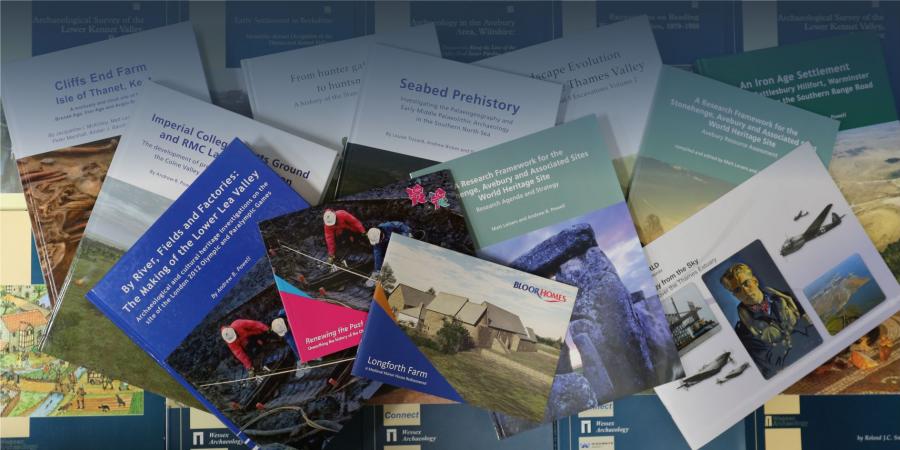
Publications for sale
Looking for our technical site reports? Visit our reports section.
All publications listed are available for purchase from Wessex Archaeology, at the cost shown, this is inclusive of postage and packing. Many of the publications can also be purchased from Oxbow Books. Free copies are whilst stocks last, and are available to UK addresses only.
Kentish Sites and Sites of Kent - A miscellany of four archaeological excavations
Kentish Sites and Sites of Kent - front coverby Phil Andrews, Kirsten Egging Dinwiddy, Chris Ellis, Andrew Hutcheson, Christopher Philpotts, Andrew B. Powell and Jörn Shuster
ISBN 978-1-874350-50-7
£10
This volume presents the results of archaeological investigations undertaken at four sites in Kent. The two ‘linear’ schemes: the West Malling and Leybourne Bypass and Weatherlees–Margate–Broadstairs Wastewater Pipeline, provided transects across the landscape revealing settlement and cemetery evidence of Neolithic, Bronze Age, Iron Age, Romano-British and Anglo-Saxon date. Two Bronze Age metalwork hoards were also recovered and a variety of World War II features.
Medieval settlement remains included sunken-featured buildings at West Malling, Fulston Manor, and Star Lane, Manston, that appear to belong to a type of building specific to Kent that had combined uses as bakeries, brewhouses, and/or kitchens. A short study of these, their distribution, form and possible functions, is included.
In addition to evidence for Bronze Age occupation, Manston Road, Ramsgate produced Anglo-Saxon settlement evidence with six sunken-featured buildings and a sizeable assemblage of domestic items.
Online specialist reports for the Margate Pipeline excavations mentioned in this volume are available online.
Clients
Southern Water, Kent County Council, Ward Homes, Tesco
Living and Working in Roman and Later London: Excavations at 60–63 Fenchurch Street
Front Cover: Living and Working in Roman and Later London - Excavations at 60–63 Fenchurch Streetby Vaughan Birbeck and Jörn Schuster
ISBN 978-1-874350-52-1
£10
Excavations in advance of redevelopment for a prestigious office building in the east of the City revealed 10 broad phases of activity, ranging between the pre-Roman and post-medieval periods, with a focus on the 1st and 2nd centuries AD.
Roman Fenchurch Street follows the line of earlier ditches. For the first time, the entire width of the Roman road has been exposed, permitting adjustment of its course in the street plan of Londinium. Iron pipe collars demonstrate water management along the street and to the rear of the 2 plots identified on site. The 17 Roman buildings (later 1st–3rd century AD) show mixed domestic and commercial/industrial uses, including metalworking and butchery.
Although disturbed by modern buildings, later Roman finds recovered from medieval and post-medieval pits indicate continuity of activity, but there is a genuine lack of Saxon occupation. A peculiar deposition of animal bone in a medieval pit may provide evidence for ritual/magic practices.
Comparison with the adjacent site of Lloyd’s Register demonstrates the considerable differences that can occur in the occupation history of two adjacent sites. The volume includes reports on the finds and environmental assemblages.
Find out more about the excavations at Fenchurch Street, London.
Excavation of Prehistoric and Romano-British Sites at Marnel Park and Merton Rise (Popley), Basingstoke, 2004-8
Excavation of Prehistoric and Romano-British Sites at Marnel Park and Merton Rise (Popley), Basingstoke, 2004-8by James Wright, Andrew B. Powell and Alistair Barclay
ISBN: 978-1-874350-51-4
£4
View the complete book online, or download a PDF of the book and specialist reports below.
This report brings together the archaeological results from two fieldwork investigations at Popley, Basingstoke (NGR 46300,154000), now known as Merton Rise and Marnel Park, in advance of housing development. The archaeological work took place during 2004–8 and was commissioned by CgMs Consulting and funded by David Wilson Homes and Hampshire County Council.
The archaeological investigation of 59 ha of mostly chalk downland revealed traces of human activity from the Neolithic through to the late Roman period, beginning with occasional pits containing domestic refuse and both Grooved Ware and Beaker pottery, the latter with evidence for cereal cultivation.
Permanent settlement occurred from about 1500 BC onwards with a series of open settlements including at least 15 buildings, mostly post-built roundhouses, of Middle Bronze Age to Early Iron Age date, whose inhabitants were involved in cereal cultivation and largescale land division. The Late Iron Age witnessed the creation of new settlements, enclosures, and trackways. Field lynchets and evidence for field clearance indicate that some earlier pasture was converted to arable. Short-lived, specialised enclosures, probably for animal husbandry, on the chalk contrasted with a long-lived complex of enclosures on poorer draining soils. The apparently low status settlement situated on these poorer soils exhibited only partly Romanised and mostly rural characteristics. The settlements were abandoned in the 4th century.
Photos from the excavations at Popley
| Attachment | Size |
|---|---|
| Merton Rise and Marnel Park Popley publication (PDF) | 1.99 MB |
| Merton Rise and Marnel Park Popley specialist reports (PDF) | 2.09 MB |
Hill Hall: a singular house devised by a Tudor intellectual
Cover: Hill Hall: a singular house devised by a Tudor intellectualby Paul Drury and Richard Simpson
544p, 378 illus, hardback in 2 parts
ISBN-13: 978-0-85431-291-7
ISBN-10: 0-85431-291-9
£55
This is the complete history of a building that began as a hunting lodge, late in the eleventh century and that grew to be the principal house of the manor of Theydon Mount in Essex, a small country retreat within easy reach of London. In 1556, the house was acquired by Sir Thomas Smith (1512-77), a man of humble origins but precocious intellect who became Regius Professor of Civil Law at Cambridge at the age of thirty and Chancellor of the University two years later. He then forsook academic for political life, becoming Master of Requests to the Lord Protector Somerset.
From 1557, Smith rebuilt the house in French-influenced classical style and decorated it with wall paintings of Cupid and Psyche and King Hezekiah, conveying complex messages of morality and affinity as part of a coherent programme of images in paint, glass and tiles.
Four centuries on, the house was first used as an open prison, then, in 1969, largely gutted by fire and finally, in 1980, taken into the care of the Department of the Environment. Archaeological excavation and detailed recording of the surviving fabric took place prior to the restoration of the house and its mural paintings, the results of which are now presented in this copiously illustrated account of one of the most important and influential houses to be built in Elizabethan England. 544p, 378 illus (2009)
For more information visit the Society of Antiquaries of London website (publications section).
Buy the book online from Oxbow Books.
Plans, sectional elevations and period plans of Hill Hall can be downloaded from the Archaeology Data Service.
Archaeological Excavations on the Route of the A27 Westhampnett Bypass West Sussex, 1992: Volume 1
Westhampnett Bypass West Sussex, 1992: Volume 1 coverVolume 1: Late Upper Palaeolithic-Anglo-Saxon
By A. P. Fitzpatrick, Andrew B. Powell and Michael J. Allen
ISBN 978-1-874350-19-4
£20
Five main excavations and a number of smaller ones were undertaken in advance of the construction of the A27 Westhampnett Bypass near, Chichester, West Sussex, in 1992. This volume presents the evidence for settlement and related evidence that spans 11,000 years from the Late Upper Palaeolithic to the medieval.
The sites examined included a Late Upper Palaeolithic palaeosol, two early Mesolithic residential base camps, isolated Early and Late Neolithic pits, an Early Bronze Age barrow and a Middle Bronze Age settlement, a Middle Iron Age settlement, an unusual Romano-British enclosure of unknown function, perhaps a shrine, and an Anglo-Saxon Sunken-Featured building.
These excavations provide the first archaeological transect across part of the West Sussex Coastal Plain and provide a useful contrast to the well-explored Sussex Downs immediately to the north.
The Iron Age, Romano-British and Anglo-Saxon cemeteries are published in volume 2.
Cambourne New Settlement - Iron Age and Romano-British settlement on the clay uplands of west Cambridgeshire
Cambourne New Settlement front coverby James Wright, Matt Leivers, Rachael Seager Smith and Chris J. Stevens
ISBN 978-1-874350-49-1
£15.00 (includes CD of specialist material). View the complete book, or download a PDF below.
Visit the Cambourne project homepage.
Twelve excavations were carried out by Wessex Archaeology within the Cambourne Development Area. Situated on the clay uplands west of Cambridge, which have seen little previous archaeological investigation, the results presented here are important in demonstrating the ebb and flow of occupation according to population or agricultural pressure.
Short-lived Bronze Age occupation was followed in the Middle Iron Age by small farming communities with an economy based on stock-raising and some arable cultivation. The Late Iron Age seems to have seen a recession, perhaps partly due to increased waterlogging making farming less viable.
From the mid-1st century AD new settlements began to emerge, possibly partly stimulated by the presence of Ermine Street, and within a century the area was relatively densely occupied. Several farmsteads were remodelled in the later Romano-British period, though none seems to have been very prosperous.
Dispersed occupation may have continued into the early 5th century at least, followed by a hiatus until the 12th/13th century when the entire area was taken into arable cultivation, leaving the ubiquitous traces of medieval ridge and furrow agriculture.
Access the online appendices and project pages for this book.
| Attachment | Size |
|---|---|
| Cambourne New Settlement - Iron Age and Romano-British settlement on the clay uplands of west Cambridgeshire | 3.35 MB |
Archaeology on the A303 Stonehenge Improvement
by Wessex Archaeology
ISBN: 978-1-874350-48-4
£9.95
This volume reports on the archaeological works undertaken between 1998 and 2003 as part of the A303 Stonehenge Improvement highway scheme promoted by the Highways Agency.
The A303 trunk road and the A344 which pass Stonehenge are widely agreed to have a detrimental effect on its setting and on other archaeological features within the World Heritage Site. Around Stonehenge there is noise and visual intrusion from traffic and also air pollution. Each year nearly one million people visit the World Heritage Site and surroundings, using visitor facilities intended to cater for a much smaller number.
Many plans that might improve this situation have been examined, involving partnership working across many organisations. Common to all these has been the aim of removing traffic from the area of Stonehenge and at the same time addressing highways issues with regard to road capacity and safety.
This volume sets out the objectives of the extensive programme of archaeological work that was undertaken to inform the planning of the highway scheme, the methods used, the results obtained, and to explain something of the significance of works which provided a 12 km transect across the WHS and beyond: the first of its kind ever undertaken.
Access the online appendices and specialist reports for this volume.
An Iron Age Settlement outside Battlesbury Hillfort, Warminster and Sites along the Southern Range Road
Cover for An Iron Age Settlement outside Battlesbury Hillfort, Warminster and Sites along the Southern Range Roadby Chris Ellis and Andrew B. Powell
ISBN: 978-1-874350-47-7
£9.99. Read the book online, or download a PDF of the full text below.
Visit the Battlesbury Camp project homepage.
Construction of a tank road through part of Salisbury Plain, from Warminster to Tilshead, has revealed archaeological remains dating from the Neolithic up to modern use of the Plain for military training. Excavation adjacent to Battlesbury Camp hillfort has uncovered Late Bronze Age to Middle Iron Age settlement activity including ditches, roundhouses, four-post structures and numerous pits. Some of the pits contained human burials, and other deposits of artefacts and animal bones appear to have been formally placed.
Detailed environmental investigation has provided information about both the nature of the on-site activities and the character of the surrounding landscape.
Other sites investigated along the tank road included a round barrow and a multiple inhumation and cremation burial of Early Bronze Age date, a Middle Bronze Age enclosure, Late Bronze Age settlement sites, the ‘Old Ditch' Wessex Linear earthwork and evidence for Romano-British settlement and landuse.
| Attachment | Size |
|---|---|
| An Iron Age Settlement outside Battlesbury Hillfort, Warminster and Sites along the Southern Range Road (PDF) | 5 MB |
The Lower Palaeolithic Occupation of Britain
The Lower Palaeolithic Occupation of Britainby John Wymer
ISBN 1-874350-29-9
2 Volumes £25 (digitally reprinted due to demand)
This volume presents a synthesis based on a comprehensive seven year survey of the Palaeolithic archaeology of England and Wales. That survey sought to identify the findspots and plot the distribution of Lower and Middle Palaeolithic artefacts in relation to the deposits containing them. This volume is concerned not only with artefacts but with people; when and where they moved through the land we now know as Britain and in interpreting, where possible, what they were doing during the half million or so years of their occupation.
It begins with a brief introduction to the period, the nature of the archaeological resource, and a history of Palaeolithic research. This is followed by detailed considerations of the geological and climatological background, the formation and importance of river terraces, of the people themselves, and of fauna and flora that existed alongside them.
The main thrust of the report is a landscape based review of the evidence, beginning with a journey along all the main river valleys. The evidence is then reviewed for occupation beside the sea, around lakes, on the downs, plains, hills and fringes of the highlands, and in caves and rock shelters. It concludes with a future research agenda which poses a number of questions. The report is accompanied by a separate volume of colour maps summarising all the major distributions by area.
The Archaeology of the M6 Toll 2000-2003
The Archaeology of the M6 Toll 2000-2003 front coverby Andrew B. Powell, Paul Booth, A.P. Fitzpatrick and A.D. Crockett
ISBN 978-1874350-1-6 £30
In late 2000, during one of the wettest winter on record, Oxford Wessex Archaeology were commissioned by the construction consortium CAMBBA, on behalf of Midland Expressway Limited, to carry out the archaeological works associated with the construction of the new 44km M6 Toll motorway.
The main phase of work was carried out during 2001, and by 2003 all investigations were complete, revealing 41 separate sites.
Remains includied Mesolithic flint scatters, isolated Neolithic pits and hollows, Bronze Age burnt mounds and Iron Age settlement enclosures. The Romano-British period was dominated by settlement and burials concentrated around Wall (Letocetum), Ryknield Street and Watling Street, whilst the Anglo-Saxons were notable by their absence from the results. Evidence for medieval settlement and agriculture was recorded at many sites, and in particular a Knights Templar fishpond complex at Wishaw. More recent standing structures were also recorded, including the northern dam for Hatherton Reservoir, Churchbridge Railway and Accommodation bridges and sections through the Cannock Extension and Wyrley and Essington Canals, vital elements of the post-medieval industrial heritage of the region.
Suburban Life in Roman Durnovaria: Excavations at the Former County Hospital Site, Dorchester, Dorset 2000-2001
Suburban Life in Roman Durnovaria front coverby Mike Trevarthen
ISBN 978-1874350 £4.95
Excavations at the former County Hospital site, Dorchester have provided a rare opportunity to examine a reasonably large area of the south-western corner of the Roman town of Durnovaria. Evidence for a series of buildings, including a late Roman town house complete with fine mosaics, was recovered as well as working areas and probable barns. A wide range of largely domestic objects and evidence for local produce was recovered as well as important evidence for allec or fish sauce and for imported wine or vine fruits, olive oil, grain and lentils. The results of the excavations are presented here in an easy to read format accompanied by many colour photographs and illustrations. The Durnovaria technical reports are available online.
From Hunter Gatherers to Huntsmen - A History of the Stansted Landscape
by Framework Archaeology
Published February 2008
ISBN 978-0-9554519-1-1 £20
The expansion of Stansted Airport provided an opportunity to investigate a large area of clay plateau, typical of the north-west Essex landscape. The area was a focus for hunter-gatherer activity as early as the Palaeolithic period, and was first settled by small farming communities in the Middle Bronze Age. From the Middle Iron Age onwards, increasing settlement and population density led to the enclosure of the landscape. Farming and settlement concentrated on the more fertile river valleys and the slopes of the heavily wooded plateau.
The Romano-British period saw a decline in the rural population, whilst increasing agricultural intensification led to the first systematic farming of the clay plateau. Woodland regeneration in the post-Romano-British period is clearly demonstrated in documentary sources. Indeed, much of the history of the Saxon and medieval settlement of the area concerns the relationship between agricultural expansion and the surrounding woodland, whilst deer parks such as Stansted Park allowed landowners to demonstrate their mastery of the landscape and its wildlife.
This book, along with its accompanying CD-ROM, presents the results of these excavations, allowing the reader to explore both broader historical themes and the minutiae of individual sites, features and finds. The results of earlier work in the area are integrated, providing a coherent historical narrative of human inhabitation.
The 18th Century Baptist Chapel and Burial Ground at West Butts Street, Poole
by Jacqueline I. McKinley
Published March 2008
ISBN 978-1874350-45-3 £9.95
An intact, 18th century Baptist burial ground was excavated in Poole, Dorset. The West Butts Street congregation was established in 1735 by 15 named members but dwindled in the 1780s. The chapel was demolished but the burial ground subsequently served a second Baptist community, Hill Street, founded in 1804, until their own church was built in 1813. Documentary research gathered a wealth of information regarding the town, its population and economic status, and the growth and spread of Nonconformity and the Baptist movement. Osteological analysis of 100 individuals has enabled some aspects of the lives of the cemetery’s population to be gleaned.
Excavations on Reading Waterfront Sites, 1979-1988
by John W. Hawkes and P.J. Fasham
Published 1997: Report 5
ISBN: 1-874350-09-8
£Free +£2.50 P&P
The growth of Reading in the medieval period was due largely to the influence of the Abbey. The waterfront zone, between the Holy Brook and the Kennet, lay at the heart of the development. A series of excvations and observations during major redevelopment of the town centre produced substantial evidence for the construction, repeated refurbishment and use of waterfront structures spanning the medieval period. A period of near abandonment seems to have followed the Dissolution. The recovery of over 100 timbers has allowed for detailed dendrochronological study and the artefact assemblages chart the varied industrial and commercial functions of the waterfronts.
Archaeological Excavations on the route of the A27 Westhampnett Bypass, West Sussex, 1992
Volume 2: the Late Iron Age, Romano-British, and Anglo-Saxon cemeteriesby A.P. Fitzpatrick
Published 1997: Report 12
ISBN: 1-874350-20-5 £5 (reduced!)
Five excavations were undertaken in advance of the construction of the A27 Westhampnett Bypass, near Chichester, West Sussex. These revealed a Late Iron Age religious site which contained over 160 cremation burials, a Romano-British cremation cemetery with a further 36 burials and an Anglo-Saxon cemetery with 10 inhumation graves.
Potterne 1982-5: Animal Husbandry in Later Prehistoric Wiltshire
by Andrew J. Lawson
Published 2000: Report 17
ISBN: 1-874350-28-0 £FREE (was £30) + £2.50 P&P
SOLD OUT!
For half a millennium, successive generations of Late Bronze Age/Early Iron Age farmers maintained their animals at the same site at Potterne. The evidence comprises a dark man-made soil, rich in artefacts, domestic and industrial waste, forming a colossal mound 3.5 ha in extent and up to 2 m thick. Exploratory excavations have led to the definition of what was a previously unrecognised phenomenon. The progressive accumulation of a vast quantity of material has necessitated a consideration of the role of farming, especially cattle husbandry, in the later prehistoric society of southern Britain.
Excavations at Carisbrooke Castle, Isle of Wight, 1921-1996
by C.J. Young
Published 2000: Report 18
ISBN: 1-874350-27-2 £FREE (was £23.50) + £2.50 P&P
A series of excavations, watching briefs and other interventions have shed new light on the history and archaeology of the only medieval fortification on the Isle of Wight. The earliest use of the hilltop was for a 6th century Saxon cemetery, followed by settlement and timber fortification in the late Saxon period. A motte and bailey replaced an earthen Norman castle in the 12th century and the castle saw repeated episodes of building and embellishment up to the 17th century. The excavations have produced good stratified sequences of medieval and post-medieval artefacts, particularly pottery, and revealed a range of domestic and other buildings.
Excavations at Billingborough, Lincolnshire, 1975-8: A Bronze Age - Iron Age Settlement and Salt-working Site
by P. Chowne, R.M.J. Cleal and A.P. Fitzpatrick with P. Andrews
Published 2001
ISBN: 1-874350-32-9 £FREE! (+ £2.50 P&P)
Extensive excavations on the fen margin at Billingborough revealed archaeological remains of considerable regional importance. A Middle Bronze Age enclosure is one of the most extensively excavated enclosures of its type in East Anglia. Late Bronze Age/Early Iron Age salt-making debris represents one of the earliest and most substantial assemblages of such material in the area. The results have led to the creation of a pottery sequence for the Bronze Age and Iron Age periods in the region.
Charter Quay: The Spirit of Change
The Archaeology of Kingston’s Riversideby The Trust for Wessex Archaeology Ltd.
Published 2003
ISBN: 1-874350-38-8 £Free +£2.50 P&P
The Charter Quay development in Kingston upon Thames occupies much of the heart of the historic town. Before construction began, archaeologists excavating the site uncovered the essential elements of the town's growth over 900 years; its urban planning, its market place businesses, shops and inns, the early industrial estate south of the Hogsmill, and the riverside wharves essential for its burgeoning trade.
Stealing away Like Time: archaeology and the River Jordan
by Andrew B. Powell ISBN: 978-1-874350-43-9 £4.95
Stealing
Away Time - front cover This colourful 16 page booklet tells the story
of the River Jordan, which rises at the base of the Dorset chalk and
meanders through the secluded village of Sutton Poyntz on its brief
course to the sea. The
history of settlement in the valley, from at
least the Mesolithic through to the present day, has revolved around
the river. The earlier settlements, and a medieval chapel, have
recently been brought to light by archaeological excavation on the site
of a new water pumping station (published in full in By a Crystal
Brook, also available from Wessex Archaeology.
By a Crystal Brook: early riverside settlement and a medieval chapel at Sutton Poyntz, Dorset
by Mick Rawlings ISBN: 978-1-874350-42-2 £9.95
This
report describes the results of several stages of archaeological work
resulting from plans to construct a new water treatment plant
utilising the springhead of the River Jordan at Sutton Poyntz, a
village at the foot of the chalk scarp near Weymouth, Dorset. Human
activity in
the area, since at least Mesolithic times, has focused on the river.
Its post-medieval history revolved around its water mills. Evidence for
an
Early Iron Age settlement and Romano-British activity, including an
infant burial were recorded, partly beneath a thick colluvial deposit.
A rectangular, stone-founded building has been identified as a
13th-14th century chapel. probably belonging to the Poyntz family
estate.
Paperback A4, 96pp, 40 b/w illustrations and halftones
Iron Age and Romano-British Settlements and Landscapes of Salisbury Plain
by M.G. Fulford, A.B. Powell, R. Entwistle and F. RaymondDecember 2006: Report 20
ISBN: 978-1-874350-42-2
£28
This volume presents the results of a series of fieldwalking surveys and excavations of Iron Age and Romano-British sites in two areas of the Salisbury Plain Training Area. Altogether some 18 new settlement sites were discovered of which 13 were Romano-British, three were predominantly Iron Age, and two produced evidence of Middle-Late Bronze Age occupation. Small-scale excavation was undertaken at eight enclosures and field systems, accompanied by targeted environmental sampling.An increase in enclosure through to the later Iron Age was revealed, when there was evidence for settlement abandonment followed by a further development of unenclosed settlement and the emergence of nucleated villages such as Chisenbury Warren in the Late Iron Age and through the Romano-British period.
Hardback A4, 248pp, 81 b/w illustrations and halftones


