News
Bronze Age Gold Treasure found in East Kent
Two Bronze Age gold bracelets almost 3,000 years old have been discovered during excavations along the route of the East Kent Access Road. When they were found one bracelet was placed inside the other.
Find out more on the Archaeology of the East Kent Access Road website.
WWII German bomber on Goodwin Sands
As reported in The Times, Wessex Archaeology has been working with the RAF Museum and English Heritage on a German bomber that was shot down in the Battle of Britain in 1940.
Sidescan geophysical sonar survey showed that the Dornier 17, known as the Flying Pencil, is very well preserved.
Walking into history
Archaeologists working on a 21st century highways project in Nottinghamshire have found evidence for Ice Age hunters dating back to the end of the last Ice Age, over 12 thousand years ago.
Work on the A46 Newark-Widmerpool has not just been about building for the future but exploring the past. Archaeological excavations have found Bronze Age burials and part of Roman town but the archaeologists are most excited about one square metre littered with tiny bits of broken flint. They are traces of an ancient campsite.
Chris Ellis, one of the leaders of Cotswold Wessex Archaeology team responsible for the dig at Farndon Fields near Newark explained ‘We have found the remains of a campsite that was used during one of the warmer periods that punctuated the last Ice Age. In these warmer periods, or ‘Interstadials’, modern humans, were able to visit regions that had just been too cold to live in. These people came from the east and south but so much water was still locked up in the Ice Caps that the North Sea did not yet exist. They could just keep on walking.’
Experts think that these Ice Age hunters lived in close harmony with the wild animals that were their prey. They followed herds of reindeer and wild horses as they migrated through an environment that was like a polar desert summer. The hunters set up temporary camps and the site at Farndon Fields is close to where the River Devon flows into the River Trent, a place that would have provided a range of habitats and a rich menu of wild foods.
Trial works in advance of the new road identified traces of these ancient remains. As a result the design of the route was changed to avoid them but because the campsites were returned to year after year, their remains do not have a neat boundary. So the Highways Agency funded the painstaking excavation. This yielded a scatter of flints dating to the Interstadial. As they have been found in the open rather than in cave they represent exceptionally rare finds.
Most traces from these times are from caves that provided natural shelters. And they have also protected the fragile remains from destruction by modern ploughing. Some of the most famous finds from Britain that date to this time have been found in Creswell Crags, a limestone gorge honeycombed with caves, 33 kilometres, or just two or three days walk from Farndon Fields. These caves have also produced the oldest cave art in Britain dating back to the same Late Glacial Interstadial as the flints from Farndon Field.
Critically, the flints found at Farndon Fields are very similar to those found in the caves at Creswell Crags and this dating is backed up by Optically Stimulated Luminescence a technique that shows when the soil was last exposed to sunlight. This demonstrates that the hunters did not only live in caves. Instead they followed herds of animals as they moved between the lower and higher ground.
Their stone tools reflect this nomadic lifestyle. Thin pieces of flint were carefully removed from larger nodules by hitting or ‘knapping’ the nodule. These flint flakes were carried on hunting trips, making sure the Ice Age people had the kit to make the exact tools they needed. Amongst the thin scatter of finds at Farndon Fields was a small concentration of tiny bits of flint. It is the waste left behind an Ice Age hunter.
Dr Andrew Fitzpatrick of Wessex Archaeology explained ‘It seems as if 12,000 years ago someone sat here knapping flints. While they worked, tiny splinters of flint landed between their legs. When they stood up, they took with them the pieces they wanted for tools. They just left the rubbish where it had fallen. Soon after that the River Devon flooded and when the waters fell they left behind a thin layer of silt that covered the flints, protecting them until today. But by then the Ice Age hunter had walked into history.’
Listen to Phil Harding discuss this site on BBC Radio 4's Today show.
Further information
Balfour Beatty is building the new road for the Highways Agency. The archaeological works have been undertaken by a joint venture between Cotswold Archaeology and Wessex Archaeology working with Scott Wilson Consultants. Trent and Peak Archaeology did earlier stages of work at Farndon Fields
Littlecote - Another EPPIC Placement
Our Littlecote EPPIC placement started in May 2010, and will run until the end of April 2011. Darren Baker is the lucky post-holder, and he will be spending the year working on the finds and environmental samples from Littlecote Roman Villa near Hungerford. This is a large and complex site – there are also medieval and post-medieval elements to it – with a substantial finds assemblage. Darren will be learning the process of recording, analysis and reporting for various finds and environmental types, under the supervision of several of our in-house specialists. Funding for our specialist supervision has come from a grant from the Roman Research Trust (RRT), via Wiltshire Heritage Museum in Devizes.
EPPIC placements (English Heritage Professional Placements in Conservation), which are designed to provide work-place learning opportunities, have been running since 2003; they are funded by English Heritage and administered by the Institute for Archaeologists (IfA). WA has already hosted several successful placements in Coastal and Marine, but this is the first such placement working in Post-excavation.
The background
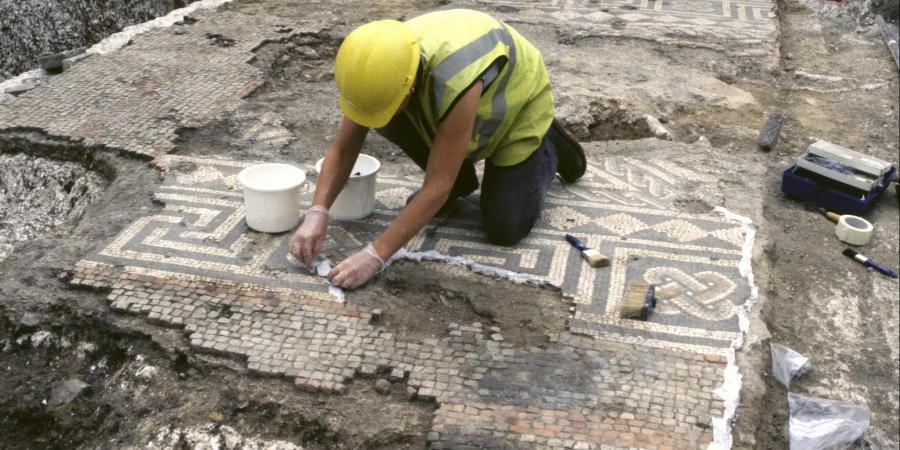
The site at Littlecote Park is located to the west of Littlecote House, just off the A4 to the west of Hungerford, and just within the border of Wiltshire. The presence of a Romano-British site in the park was first recorded in 1727, when a well-preserved mosaic floor was found, and this was later relocated in 1976. To the south of the house are the earthworks of the medieval village of Littlecote. Overlying the remains of the Romano-British buildings, a hunting lodge was built in the mid 17th century, and remained in use until being demolished in the later 18th century.
Excavation on the site, under the direction of Bryn Walters and Bernard Phillips, ran from 1978 to 1991, and eventually covered more than one hectare. The excavations were funded first by the landowners, and subsequently the RRT. Since 1991, a certain amount of post-excavation work has taken place, and interim reports have been published, but the site has not yet been brought to full publication.
In 2001 WA undertook a rapid assessment of most of the finds and environmental material for the RRT. The assessment confirmed the finds assemblages as being generally of regional importance, and for certain categories of material of national importance.
Darren’s task
At the time of the assessment in 2001, the finds archive comprised around 1000 boxes, but this has now been reduced somewhat by the ‘weeding’ of the ceramic and stone building materials, and oyster shell. However, the remaining finds assemblage is still substantial – about 115,000 sherds of pottery, over 300 coins, about 3000 other metal objects, about 2000 fragments of vessel glass, and about 3700 pieces of wall plaster.
The main part of Darren’s work will be to provide basic catalogues of most of these categories. A certain amount of information already exists, but as yet we have only been able to access this in hard copy – Darren is entering all information into a database. The placement is also designed to help Darren understand both how and why we analyse finds and environmental material, and to give him an opportunity to use his new-found knowledge to prepare publication reports.
Ancient Past inspires Modern Art
Staff arriving at Wessex Archaeology's Salisbury office from the west have been startled to see what looks like a huge Bronze Age axe on a roundabout.
Well, it is a huge Bronze Age axe rising from a barrow. And it is part of the public art associated with the adjacent housing development by Persimmon Homes.
Before building work started Wessex excavated the site of the housing. One of the finds was a barrow and this provided the inspiration for the artists Angela Cockayne and Robert Fearns of Forge Projects.
When viewed from the east, the Iron Age and Norman monuments at Old Sarum provide the backdrop. From this side you can also see on the shaft of the axe the coordinates of the roundabout. This is a reference to landscape, monument, and mapping. Near to the site an iron cannon was sunk into the ground as a survey baseline for the 18th century trigonometric survey of Britain. Wessex provided the GPS data to the artists.
Other plans for the public art include planting flower bulbs over the site of the Bronze Age barrow.
We will update this post when the installation is complete. The coordinates on the Bronze Age axe sculpture, read: E414814.5, N133332.3, H77.538MOD.
Heritage leaders announce merger to create ‘Britains largest heritage service’
Wessex Archaeology and Cotswold Archaeology announced today that they are in discussion about merging. The two companies who are market leaders in the sector will come together to offer clients what Sue Davies the Chief Executive Officer of Wessex Archaeology described as ‘the most complete and widest range of heritage services in Britain.’
The two organisations, both of which are charities, will be undertaking a process of due diligence over the coming months and anticipate announcing the result of that in the autumn.
Neil Holbrook, the CEO of Cotswold Archaeology said ‘the merger will create an organisation with 300 staff based in 5 offices across the UK. We will be able to meet the increasing demand for a nationwide service that is both comprehensive and competitive.’
Shipwreck dive videos online
Four videos, each exploring a historic shipwreck or protected submarine subject to designation under the Protection of Wrecks Act (1973), have been made available online. The videos are available on YouTube, and explore the sites of the Wheel Wreck, HMS/m Holland V submarine, HMS/m A1 submarine and HMS Drake which lies in Irish waters.
These videos were made by Jenny Austin and Alex Pope who joined Wessex Archaeology in October 2009 to gain work experience with the Coastal and Marine team.
They took video footage recorded by our divers during routine surveys in support of the Protection of Wrecks Act 1973 and edited them into video clips exploring each of the wrecks. Background information is given by an informative voice over explaining the history of each site.
Find out more about the work and discoveries of our Coastal and Marine Archaeology section.
View more videos on the Wessex Archaeology YouTube Channel.
The Festival of British Archaeology 2010
The Festival of British Archaeology is your unique chance to discover and explore the archaeological heritage of the United Kingdom. For the two weeks of the festival, which will run from Saturday 17th July to Sunday 1st August, you can take part in excavation open days, hands-on activities, family fun days, guided tours, exhibitions, lectures, ancient art and craft workshops and much, much more.
Wessex Archaeology will be supporting the Pilgrims and Pageants event at Salisbury and South Wiltshire Museum in Salisbury. Our Explore the Seafloor team will be on site at English Heritage's Centre for Archaeology at Fort Cumberland, Hampshire, to help visitors learn about the geology, archaeology and ecology of the seafloor with a range of interesting boards and hands-on activities. We will also be at the Kent County Show at Detling, Friday 16th - Sunday 18th July. Oxford Wessex Archaeology we will be giving the latest news about the discoveries made in this year’s biggest dig, the East Kent Access Road.
Find out about events near you on the Festival of British Archaeology website.
‘The Festival of British Archaeology is the Council for British Archaeology’s flagship event, a national archaeological extravaganza with hundreds of events which showcase the best of British archaeology and allow everyone to see archaeology in action. This year CBA is celebrating its 20th anniversary of coordinating this major event’.
Pilgrims and Pageants - Free event at Salisbury and South Wiltshire Museum
![]()
Saturday 17th July 2010, 10.00 am – 4.00 pm
This summer join Salisbury and South Wiltshire Museum as we celebrate the Museums 150th anniversary during the annual Festival of British Archaeology. Inspired by our summer exhibition, Made in 1860, this free event has something for all ages and is a wonderful opportunity for visitors to explore Salisbury’s medieval past.
Families will have a chance to try out lots of hand on activities such as creating a fantastic costume, mask, puppet and banner, and taking part in our medieval pageant at 3pm. There will also be a chance to have a go in our ‘mock’ medieval archaeological dig and make your very own souvenir pilgrim badge to take home.
There will be some very special guests joining us for the day including Channel 4’s Time Team archaeologist, Phil Harding. Phil, who works for Wessex Archaeology, will be talking about his experiences on the programme including his recent chance to finally excavate within his home city at Salisbury Cathedral. Plus meet the knights from the British Plate Armour Society who will be here all day doing battle in the museum’s garden. Watch them perform their foot tournaments, try on some armour, handle some medieval weapons and have a go at archery in ‘shoot the knight’.
Throughout the day there will also be the opportunity to go ‘Behind the Scenes’ of the museum and explore the Medieval City with a guided tour led by Margaret Smith, a Blue Badge Guide (booking required). The city tour also runs on Friday 16 July at 2.00pm, booking required.
Once again Wessex Archaeology, The Wiltshire Conservation Service and Salisbury Cathedral will be joining us to help create a wonderful day of activities. There is also a chance to bring along those unknown artefacts for Katie Hinds, the Wiltshire Finds Liaison Officer, who will help to identify your own archaeological discoveries.
To find out more please phone 01722 332151 and direct your enquiry to Jane Ellis-Schön, Collections Manager, or email her at archaeology@salisburymuseum.org.uk

Wessex sponsor major Wind Farm Conference
Wessex Archaeology is sponsoring a major conference on Wind Farms and the Historic Environment.
The event is being organised by Northumberland County Council and is being hosted by Newcastle University.
The one day conference will take place on 6th September 2010 at Newcastle University.
The conference will include contributions from national and local government representatives and heritage advisors, representatives of the renewable energy industry, cultural heritage professionals, barristers specialising in renewable energy casework and other professionals working in the sector. It will include a paper given by Dr Antony Firth, head of our Coastal and Marine archaeology section.
View the Wind Farms and the Historic Environment conference website to secure your booking.
Celtic feasts and Roman luxury
The Heritage Lottery Fund is awarding a grant of £36,600 to an exciting new project which aims to put people in north Wiltshire in touch with their prehistoric past. ‘Celts and Romans in North Wiltshire’ will investigate the rich archaeological heritage of north Wiltshire and involve teams of volunteers in exploring the Iron Age and Roman legacy of their area.
The project focuses on two sites, Chiseldon near Swindon and Truckle Hill near Chippenham. Until a few years ago both sites were unknown and then within a couple of years of each other, a unique hoard of Celtic cauldrons was unearthed at one and completely new Roman buildings were found at the other.
![]()
Explaining the importance of the award, the Heritage Lottery Fund's Head of Region for the South West, Nerys Watts, said: ‘We are particularly pleased to be able to help this project which brings two important and exciting archaeological sites to the attention of a wide range of people, particularly the young and disadvantaged. One of our key aims is to help people become actively involved with their heritage so we were keen to support this project that will involve volunteers at every stage.’
You will be able to follow their progress through regular blog posts and podcasts on our website.
Explore the Seafloor at London Aquarium
Explore the Seafloor team member Rhonda Steel helps young scientists investigate underwater archaeologyWessex Archaeology staff will be at London Aquarium from the 22nd until the 30th of May as part of the Explore the Seafloor project.
The project, funded by the Marine Aggregate Levy Sustainability Fund, explores work undertaken to protect the marine environment from the impacts of aggregate extraction. Scientists have studied the ecology, geology and archaeology of the four main dredging regions and throughout 2010 the Explore the Seafloor Team will be working with Sea Life centres around the country to present the results of their work interactively.
Explore the Seafloor is supported by a website and later this year our team will be producing educational material and resources for use in schools and universities. Find out more about the project by following us on Twitter and Facebook, and visit us at events throughout the country this summer.
Archaeology of the East Kent Access Road
A new road is to be built on the Isle of Thanet in east Kent during 2010-11. The road will be 6.5 km long and will cross one of the richest archaeological areas in Britain.
Before construction begins archaeologists will excavate the whole length of the route. This will be the largest excavation in Britain in 2010, covering approximately 40 hectares.
The archaeological work is being done by the Oxford Wessex Archaeology joint venture on behalf of VolkerFitzpatrick Hochtief who are building the new road for Kent County Council.
Visit the Archaeology of the East Kent Access Road website to follow the excavations and to find out how you can join in.
Excavation continues near to Weatherlees Power Station at the southern end of the road scheme.
Help choose the next UK World Heritage Site
The UK Government is preparing a new Tentative List of natural, cultural and mixed sites for potential nomination for inscription on the UNESCO World Heritage List, to be submitted to UNESCO in 2011, with a view to putting forward nominations to the World Heritage Committee from 2012.
Applications are invited from Local Authorities and others throughout the UK, the Overseas Territories and Crown Dependencies, and will be assessed by a panel of independent experts appointed by Government
Find out more on the DCMS consultation website.
New light on Kent's past
Kentish Sites and Sites of KentA book shedding new light on Kent's history Kentish Sites and Sites of Kent was launched yesterday at County Hall, Maidstone. Finds from the four excavations reported in the book were on display and there was a demonstration of flint knapping from Phil Harding before the book was formally presented to Councillor David Brazier, Deputy Cabinet Member for the Environment and the Council's Heritage Champion.
Councillor Brazier commented 'the range of techniques that archeologists use today is impressive. Experts can look at tiny remains of ancient seeds and say what crops prehistoric farmers were growing. High powered scientific techniques like radiocarbon dating give accurate dates back into prehistoric times. The results are fascinating and all this work has come about because of intervention by the County Council's own archaeological team.'
The book tells the story of four excavations across the county which discovered finds ranging in date from the Stone Age to medieval times. Some of the key finds include a hoard of Bronze Age axes over 2,500 years old found at Weatherlees, an Iron Age farmstead at West Malling with evidence for textile making, Anglo-Saxon buildings at Ramsgate, and a medieval bakery or brewery at Sittingbourne.
Kentish Sites and Sites of Kent book launch: Phil Harding, Councillor David Brazier of KCC, and Keith Jeffrey of Southern Water
Lis Dyson, Kent County Council's County Archaeologist said 'Today most archaeological excavations are done before new development. This makes sure that we can find out about the County's heritage before building starts. It might seem unlikely but a water pipeline, a road bypass, a supermarket and a new housing development have each provided important new evidence for Kent's history.'
In welcoming Councillor Brazier Sue Davies, Chief Executive of Wessex Archaeology said that she was pleased to introduce this first volume dedicated to sites in Kent. With a new Wessex Archaeology office in Maidstone, she hoped that the book would be the first of many. She also commented on how three of the excavations reported in Kentish Sites and Sites of Kent had discovered medieval bake houses or brew houses. Dating to between the 11th and 14th centuries this type of building has so far only been found in Kent and appear to be distinctive to the county.'
The book is available for purchase in our books section.
New fleet of survey instruments: Leica Viva
Leica Viva SmartRover: One of our new Leica Viva SmartRover dGNSS instrumentsWessex Archaeology are pleased to announce the arrival of our brand new fleet of survey instruments from the Leica Viva range of Global Navigation Satellite Systems (GNSS).
These newer GNSS instruments can recieve signals not only from the United States GPS satellite constellation but also the Russian GLONASS constellation, the Chinese COMPASS constellation and soon the European Galileo constellation.
Our new Viva instruments are are all SmartNet enabled. This uses mobile phone networks to provide real-time correction signals from OSNet, the Ordnance Survey's correction signal network. This enables us to begin surveying on most sites within minutes.
We have also upgraded our Total Stations to use the new Viva controllers giving us a single platform for all of our survey instruments; this ensures commonality across the fleet with the same interfaces and data structures in operation irrespective of the instrument used.
The improved interface design and modular nature of the instruments allows us to build on our already highly efficient survey processes, keeping us at the cutting edge of archaeological survey techniques.
Work on the next version of our in-house survey processing software using the latest features available on the Viva instruments is also underway; this will further advance our on-site recording methodology and increase the ease with which we can use survey data in our post-excavation GIS and database based processes.
More information
For more information on our Geomatics services available to clients, see our Geomatics services page or contact Paul Cripps.
For more information on GNSS, see the Inside GNSS website.
For more information on real-time kinematic dGNSS systems in the UK see the OSNet website and Leica Smartnet website.
The University of Sheffield Department of Archaeology and Wessex Archaeology – Sheffield
The University of Sheffield’s Department of Archaeology and Wessex Archaeology are pleased to announce the establishment of a partnership between the two organisations. Following the closure of ARCUS (Archaeological Research and Consultancy at University of Sheffield), the new partnership with Wessex Archaeology will ensure in the short term that disruption for former ARCUS clients is kept to a minimum.
In the longer term, the Department of Archaeology and Wessex Archaeology plan to work together across a wide range of areas building on the strengths of both organisations. Joint activities will include: graduate training, student work placements, topics for student dissertations, community projects, specialist analysis and joint research projects.
Wessex Archaeology has now opened an office in Sheffield and the team based there includes a number of ex-ARCUS staff thereby ensuring that crucial regional knowledge and expertise are retained. The two Senior Project Managers, Oliver Jessop and Richard O’Neill, are leading experts in historic buildings and landscapes, and excavation and publication respectively. Wessex has appointed Chris Moore as the Regional Manager based in Sheffield. Chris’s expertise lies in heritage management and especially environmental impact assessment work.
The opening of a Sheffield office is part of a strategy of regionalisation for Wessex Archaeology and is in addition to their Salisbury HQ and an office in Maidstone.
The main contacts at Wessex Archaeology will be:
- Chris Moore, Regional Manager Sheffield, for all commercial enquiries and
- John Lewis for developing the partnership with the University of Sheffield’s Department of Archaeology
The main contact at the Department of Archaeology will be:
- John Bennet, Head of Department.
Contact details
- Chris Moore: c.moore@wessexarch.co.uk; telephone 0114 255 9774
- John Lewis: j.lewis@wessexarch.co.uk; telephone 01722 326867
- John Bennet: d.j.bennet@sheffield.ac.uk; telephone 0114 222 2900
Visit the University of Sheffield's Department of Archaeology website.
Archaeocast 14 now available
The latest edition of Archaeocast, our archaeology podcast, is now available. Listen to Archaeocast 14 and catch up with our Coastal and Marine geophysical survey team as they continue to study the submerged prehistory of aggregate licence Area 240 in the North Sea.
If you would like to, you can subscribe to Archaeocast via iTunes (it's free), and receive the latest episodes automatically.
Two new ebooks online
Two of our recent books are now available to download for free. The titles An Iron Age Settlement outside Battlesbury Hillfort, Warminster and Sites along the Southern Range Road, and Cambourne New Settlement can both be viewed online via the Scribd iPaper viewer, or downloaded as a PDF.
A few hard copies of both titles are still available to buy.
Cambourne New Settlement front cover
Cover for An Iron Age Settlement outside Battlesbury Hillfort, Warminster and Sites along the Southern Range Road
Wessex Archaeology opens new office in Sheffield
Wessex are pleased to announce the opening of a new office in the City of Sheffield. This new addition significantly strengthens our national service and complements our existing regional centres in Salisbury and Maidstone.
The Sheffield office covers the north of England and offers the full range of archaeological services. These includes historic buildings and landscape surveys; evaluation, excavation and watching brief; desk-based assessments and Environmental Statements; and all aspects of post-excavation and publication.
We are delighted that our two key senior managers in the office, Richard O’Neill and Oliver Jessop, are already well known locally, having many years experience of working in Sheffield and the north of England.
For more information contact:
Richard O’Neill on 07876 507943 r.oneill@wessexarch.co.uk
or
Oliver Jessop on 07770 605256 o.jessop@wessexarch.co.uk
Wessex Archaeology - Sheffield
Unit R6, Sheaf Bank Business Park, Prospect Road, Sheffield S2 3EN
Tel: 0114 255 9774