News
Kingsmead Exhibition Proves Popular with the Public
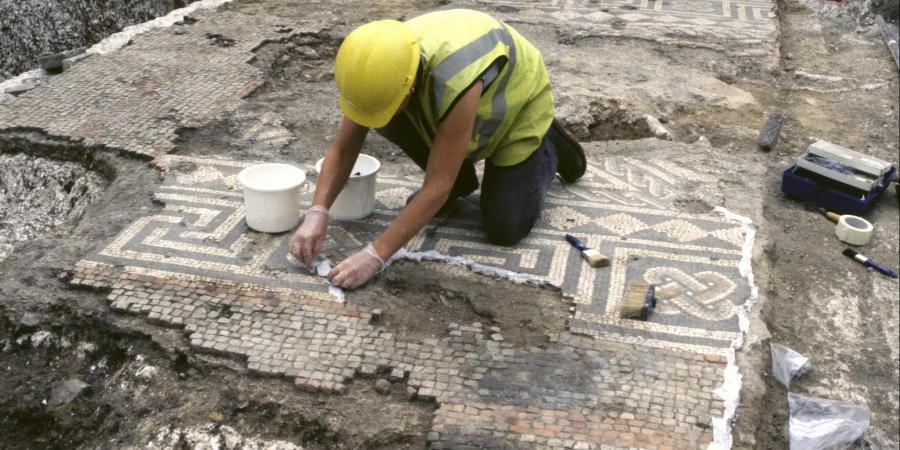
On Saturday 27th April 2013 we held an open day for the public and local residents to learn more about the exciting discoveries made at the CEMEX UK run Kingsmead Quarry, Horton near Wraysbury.
Scottish Diver Magazine
The latest edition of the Scottish Diver Magazine includes an article on Project SAMPHIRE, a Coastal & Marine archaeology project for the west coast of Scotland. The project brings together local communities, divers and professional underwater archaeologists to support the identification, investigation and understanding of Scotland’s marine heritage.
University of Southern Denmark
Paul Baggaley has just returned from Bremerhaven, Germany, where he spent the week giving a practical course in marine geophysics to staff of the National Maritime Museum of Germany and students from the MA in Maritime Archaeology course from the University of Southern Denmark.
Extracting the Past
Visualising the Beaker Burial
The two artist’s reconstructions are an impression of how the person may have looked during their life, and when placed in the grave. We know that the skeleton was that of an adult aged 35 or over and that they were placed in a crouched position, resting on their right side, facing east with their head towards the south – a rite that tends to be reserved for females at this time. Although the skull could be lifted in a soil block the bone was too degraded to attempt any form of accurate facial reconstruction – the face is that of the female artist!
Beaker Bones, Brickearth and Beads
Why there are no images of the skeleton
Pottery & Animal Bone Identification Workshop
On Saturday 20 April, 13 members of the Damerham Archaeology project took part in a pottery and animal bone identification workshop at the Wessex Archaeology offices in Salisbury. The Damerham Project, led by Martyn Barber of English Heritage and Helen Wickstead of Kingston University, is looking at cropmark sites mapped from aerial photographs around the village of Damerham on the Hampshire/Dorset border. Last year’s fieldwork, on a long barrow, dug through a post-medieval quarry, as well as part of the barrow ditch.
Beaker burial
Archaeological excavations at CEMEX’s Kingsmead Quarry in Berkshire not far from Windsor have revealed a rare 'Beaker' burial of 'Copper Age' date (2500-2200 BC). Found within the grave were some of Britain’s earliest gold ornaments (five tubular beads), along with 29 bead fragments of amber and 30 beads of black lignite.
The burial contained the possible remains of a woman who was at least 35 years old. At the time of her burial, she wore a necklace containing small tubular sheet gold beads and black disc beads of lignite - a material similar to jet. A number of larger perforated amber buttons/fasteners were also found in a row along her body, which may indicate that she was wearing clothing, perhaps of patterned woven wool, at the time of her burial. Further lignite beads from near her hands suggest that she wore a bracelet.
Beaker using communities lived across Europe around 2,500 BC around about the time of Stonehenge. In more Western regions, such as Britain, they were the first people to use copper and gold (giving rise to the term Copper Age or Chalcolithic). They buried their people in special ways, characteristically with a distinctive type of pot, known to archaeologist as a Beaker. They were also buried with other fine objects such as metal, stone and bone.
UK Archaeological Science 2013
Teenagers dig deep on Salisbury Plain to expand Blue Skies horizons
Teamwork and leadership are at the heart of our Blue Skies programme. I am really excited that the Jon Egging Trust will be working with such established teams as Wessex Archaeology and the Defence Infrastructure Organisation to develop these skills in our young people. They will get an insight into a unique team environment, which will complement the opportunities for personal development provided by our other inspirational partners, including MoD Boscombe Down and Salisbury Plain.