News from Wessex Archaeology

The Amesbury Archer: pilgrim or magician?

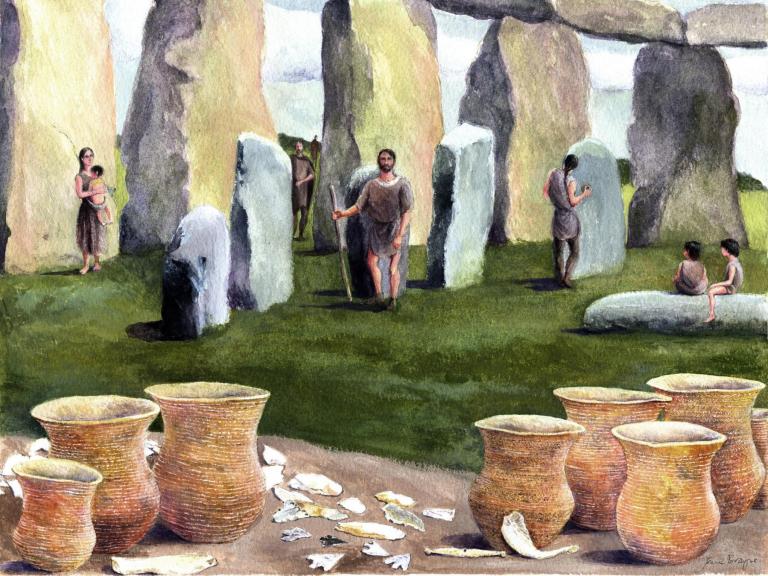
The BBC Timewatch programme Stonehenge interprets the mysterious stone circles of Stonehenge as a temple built around 2,300 BC to which people came in search of healing. The Amesbury Archer is described as ‘one of most important archaeological discoveries in Britain.' He is called the Archer because of the stone arrowheads buried with him.
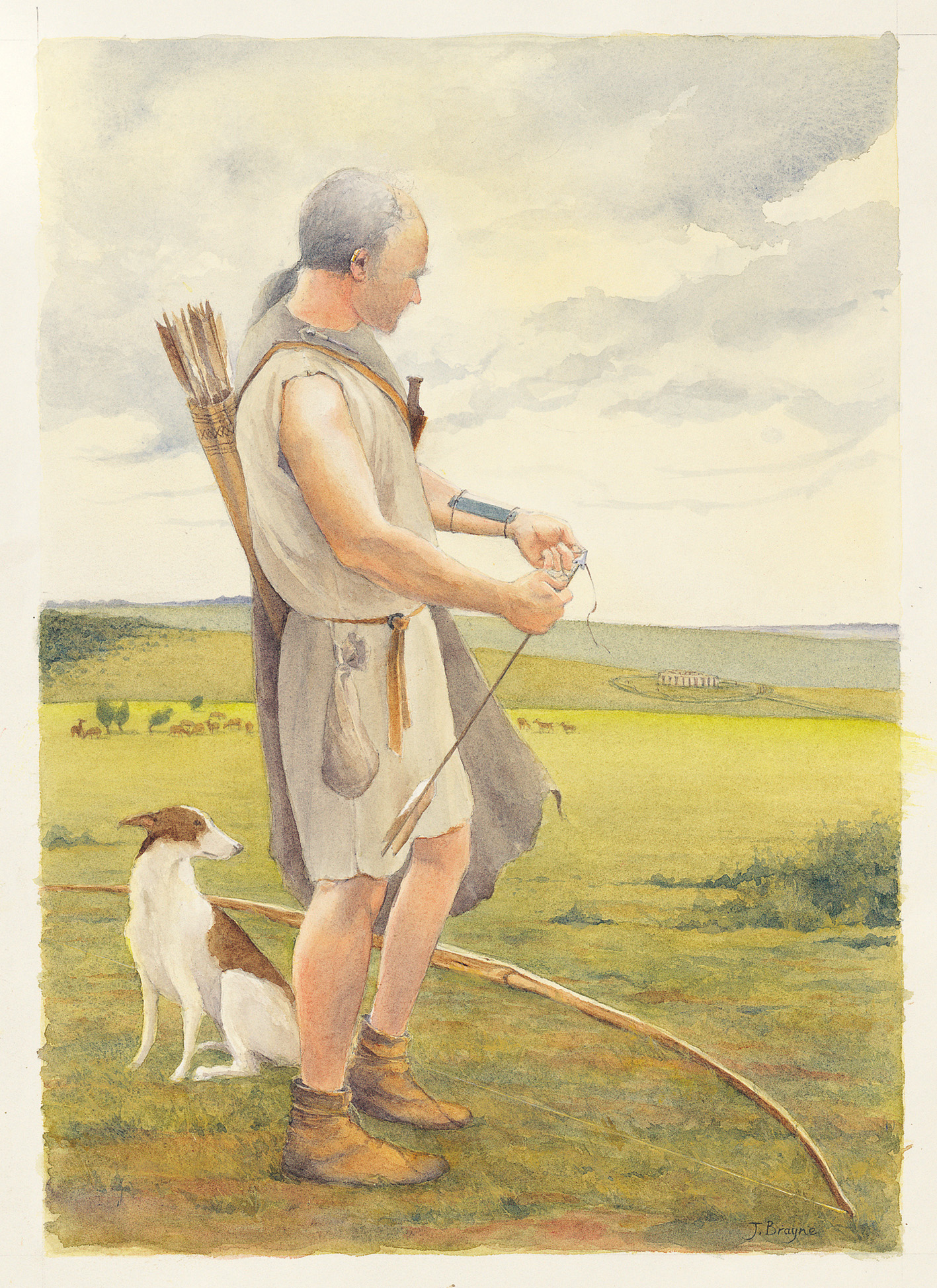
Artists interpretation of the Amebury ArcherArtists interpretation of the Amebury ArcherThis man, who lived between 2470-2280 BC, died not far from Stonehenge. By then he was between 35-45, but isotope fingerprinting of his teeth showed he was born far away, probably in the Alpine area of central Europe.  Near to him lay the grave of a younger man who was a relative. This man, his ‘Companion,' had been brought up in not far from Stonehenge, but as a child he may have travelled, perhaps even to central Europe.

Years before he died the Archer suffered a traumatic injury in which he lost his left knee and this led an infection of the wound that penetrated his very bones. He lived in constant pain from this wound, and as he put his weight on his good leg it grew stronger and the damaged leg withered. A tooth abscess also ruptured his jaw, and the infection that this caused may have led to his death.

The Timewatch programme argues that the stones brought from Wales to Stonehenge - the Bluestones - had healing powers. That is why, between 2,400 and 2,200 BC, they were carried over 150 miles, across land and over sea. Did the Amesbury Archer travel from near the Alps to Stonehenge motivated to find relief, to get better?
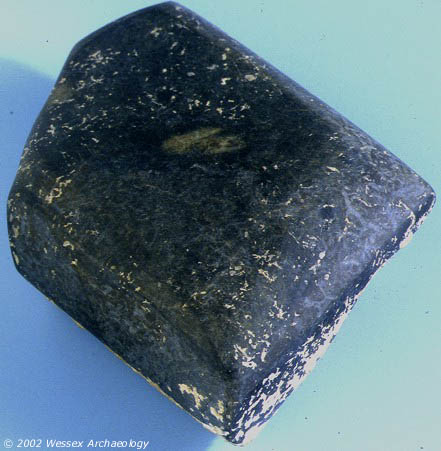
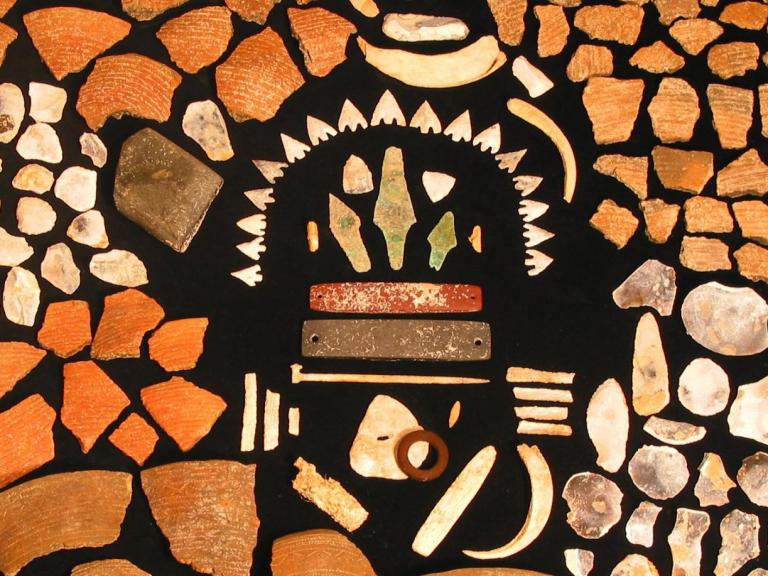
The Archer's Cushion Stone, used in metalworkingThe Archer's Cushion Stone, used in metalworkingPerhaps the Archer sought magic. But he brought magic with him. In his grave was what at first sight looks like a small, black, stone. Its significance is that it was a metalworker's tool. And it identifies him as the oldest metalworker yet found in Britain. The gold hair ornaments buried with him are also the oldest gold objects yet found in Britain. The Amesbury Archer lived at the very beginning of the metal age in Britain.

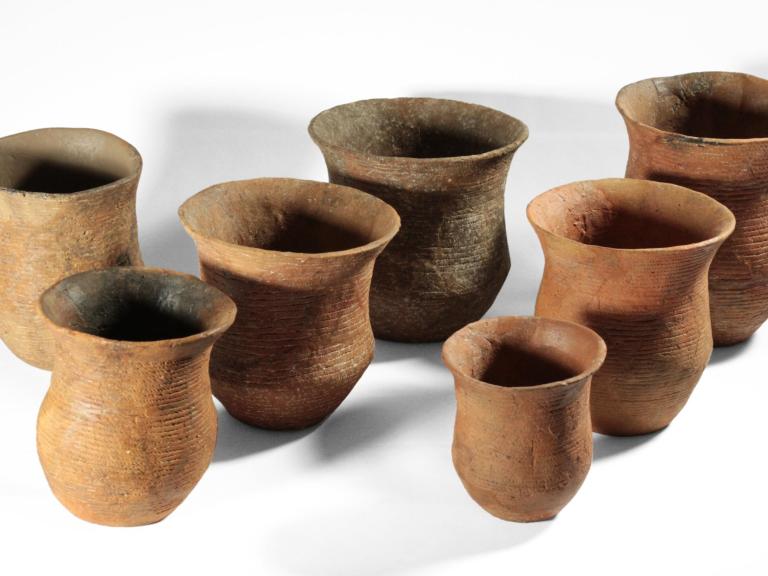
Those skills had to be brought to Britain from across the Channel, carried by people like the Archer whose cultural links were with what archaeologists call the ‘Beaker culture'. These metalworkers had the practical skills in their hands and the knowledge of how to make metal objects in their heads.

Living at the beginning of the metal age, did the simple black stone eventually buried with the Archer give him a passport to travel through Europe? Was the status with which he was buried due to him having gained some relief from his illnesses at Stonehenge? Or was it, like many of the richest burials in continental Europe of this time, because of their new and seemingly magical skills in transforming stone to metal?

Have your say in the comments below!

The Boscombe Bowmen: builders of Stonehenge?

Radiocarbon dates do not provide exact historical dates, like 1066. They are statements of the statistical probability of a date range. The date range of the burial of the Amesbury Archer overlaps with the initial interpretation of the new radiocarbon dates for the bluestone circle at Stonehenge, which are given as 2,400-2,200 BC.

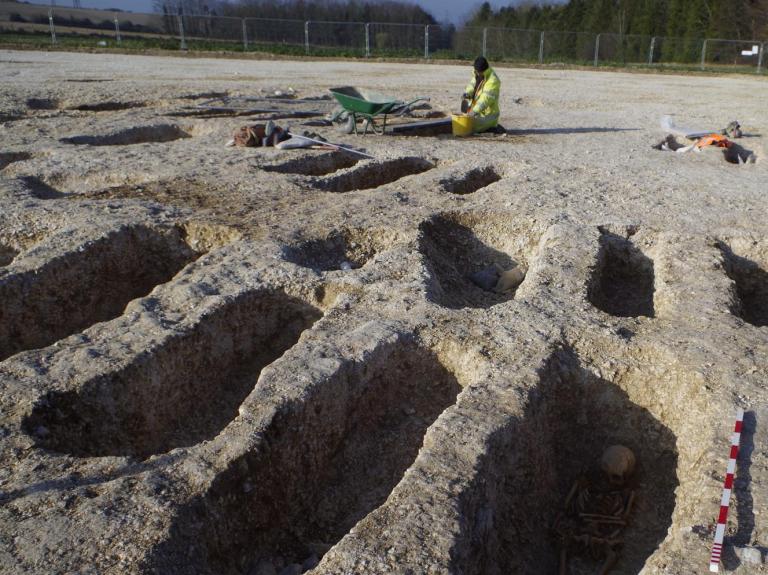
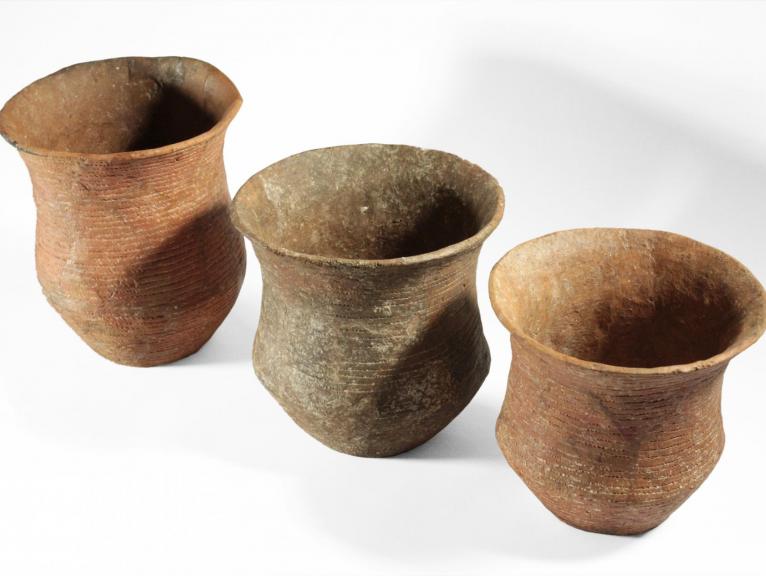
Another very important ‘Beaker culture' grave, and which has a good match with the date range of 2,400-2,200 BC given in the programme for the first arrival of the bluestones at Stonehenge, is that of the Boscombe Bowmen. This grave, a simple grave cut into the chalk, was found 1km away from the graves of the Amesbury Archer and his Companion.
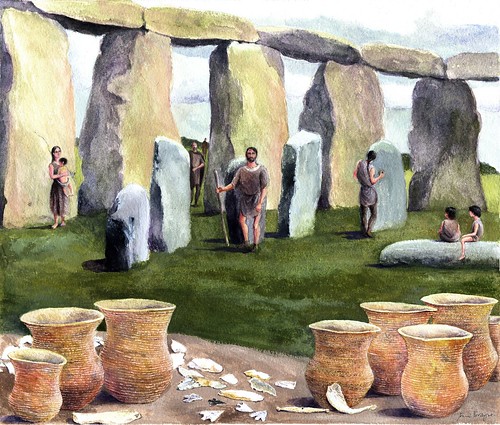
Boscombe Bowmen - an artist's interpretation

The grave of the Bowmen was different because it is a collective burial; it contains the remains of at least 7 people. Like the grave of the Archer, the Bowmen's grave also contained stone arrowheads and Beaker style pottery.

The way in which the Bowmen were buried is unusual for the time. Only parts of their skeletons were present, and before then these bones seem to have been buried elsewhere. It is difficult to find close parallels for this way of burial in Britain or elsewhere in Europe.
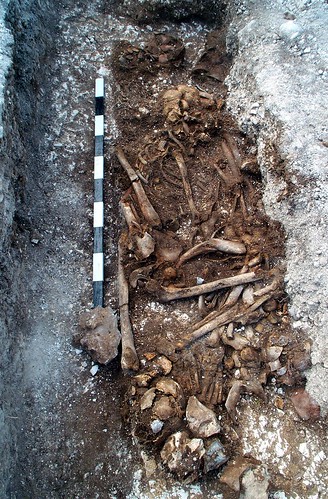
Boscombe Bowmen - mass grave

The isotope fingerprinting of the teeth of three of the young men buried in the grave showed that, like the Amesbury Archer, they were not local. One of the few places in Britain that matches the strontium and oxygen isotope fingerprints of the Bowmen is Wales.

The igneous rocks of Armorica in north-west France provide another possible origin, experts suggest. The strontium isotopes can be matched but the match for the oxygen isotopes is not as good. However, in Armorica it is not unusual for several ‘Beaker culture' burials to be found close by and it has been wondered if this is a more likely homeland for the Bowmen? In favour of this idea is that by shortly after 2,000 BC there were close links between Wessex and Armorica?

Against the idea is the view that although some burials in Armorica may be found close by, they were still the burials of individuals and not a collective grave. These burials were often placed in Stone Age megalithic tombs that were being re-used. In contrast, the Bowmen were buried in a simple grave cut into the chalk.

More important is the key scientific fact about the Boscombe Bowmen. This is that their isotopes show that they had migrated when they were children. They can be shown to have been in one place at about the age of 5 when their first permanent teeth grew, and in another at about the age of 12 when their last permanent teeth grew. Both places were different from the place they were buried as young men. This is the best isotope evidence for migration in prehistoric Europe.

Archaeologists and scientists cannot be sure of where the Boscombe Bowmen came from. But does the new dating of the bluestones at Stonehenge now suggest that Wales is the most likely homeland for the Bowmen? When they were children, did the Bowmen make a journey in which the adults who brought the bluestones from Wales to Stonehenge had led the way? Or like the Amesbury Archer, did they come from continental Europe? Were they pilgrims from France?
What do you think? Feel free to leave a comment below (comments may take a few days to appear here, as we have to approve them manually).

Groups:

Comments

A really good post the

A really good post the images compliment it really well. There are many theories, the one I have brought into is the theory that it was a kind of therapy centre... but who knows.

Thanks for your comment. As

Thanks for your comment. As you know the consensus amongst geologists is that Salisbury Plain was not glaciated so the bluestones could not have been brought by glaciers. The challenge for those who believe that it was glaciated is provide evidence which persuades people to change their opinion. If there was, as you say, a train of bluestones which were all collected, why did people only collect the bluestones and where is the edvience for all the many other types of stone that would have been brought by glaciers? There are certainly questions to be asked of the archaeological interpretations but isn't the the big question here about geology?

You are right to say that

You are right to say that the exact dating of Stonehenge is still very uncertain. What is needed is a well dated and reliable stratigraphic sequence for all the phases of the monument and a lot of high quality radiocarbon dates. At the moment we some of this but not enough. The Archer and the Bowmen do not provide a form of proxy dating for Stonehenge but they are important finds in their own right.

Thanks for your question.

Thanks for your question. The cushion stone is made of lydite. Unfortunately we cannot be precise as to where it comes from as the rock is found quite widely. No fragments of bluestone were found in the Archer's grave. A comment in a newsaper saying that there are some was a mistake.

What type of stone is the

What type of stone is the Black cushion stone you mention? Did you find any Bluestone from Wales in the grave? PeteG

Perhaps if the Amesbury

Perhaps if the Amesbury Archer or Boscombe Bowman had been placed in the foundation of pillar 22 (Atkinson's final) and the Sarsen placed on top of him, the radiocarbon date of his death would be of significance. But then only if it could be proved without doubt that he died from being crushed, and had not been placed already dead as a structured deposit. As long as the tag on the sample reads "from base of socket" you don't have a reliable date for when the stone was originally placed, and not even for when it was removed, especially when Prof. Darvill explains how the area had been extensively reworked, possibly even excavated before but unrecorded. Or are we to believe the good Professor and his predecessors carefully replaced the soil in the order in which it had been removed? The important question is not from where the Archer or Bowman came, but when Stonehenge was built. That was the challenge the Professors gave themselves, and it was not answered. But it could be: http://www.louistalboys.com/stonehenge/article6.htm

Enough of fantasy. We've

Enough of fantasy. We've had quite enough of it from Profs Darvill and Wainwright on the recent Timewatch programme. Can I just try to inject a bit of reality here? The bluestones used in the iconic megalithic structure at Stonehenge are glacial erratics after all. That is the clear message coming out of new geological research into the nature and provenance of the stones. In the last few years the bluestones have been subjected to an unprecedented battery of geological tests (which Wessex Archaeology cannot fail to have noticed), and it is now apparent that the stones cannot possibly have been collected from West Wales by our Neolithic ancestors. In a number of publications arising from studies by an Open University team, the following results are reported: ** The bluestones have come from at least fifteen different localities in West and South Wales, and other areas as yet unidentified. It is inconceivable that a Neolithic "stone collecting expedition" can have collected all these stones, of many shapes and sizes, from so many different locations. ** The bluestones were present on or near Salisbury Plain at least a thousand years before the first stone monument was built at Stonehenge. ** Some of the bluestones at Stonehenge (for example, made of volcanic ash and soft sandstone) are "rubbish stones" which would never have been selected for incorporation into a megalithic monument. They were used simply because they were conveniently located close to the building site. ** There is no evidence that the "spotted dolerite" so beloved of archaeologists was ever viewed as sacred or magical. It was never used preferentially, either in Wales or Wiltshire, in megalithic structures or burial sites. ** Studies of hand axes made of spotted dolerite and found in England suggest that they were actually made from the same stones that were built into the monument. In other words, Stonehenge was at one time the site of a stone axe factory. ** None of the stone settings at Stonehenge was ever finished. Whatever might have been the grand designs of the "architects", the builders never had enough stones to finish the job. New research into the glacial history of southern England also suggests that at one time the ice of the great Irish Sea Glacier came in from the west and reached at least as far east as Bath, the Mendip Hills and Glastonbury. It is still uncertain whether the ice covered Salisbury Plain, but it is now thought that an "erratic train" of stones of all shapes and sizes was left in the landscape to the west of Stonehenge. It was an easy matter for the Stonehenge builders to follow this trail westwards, and to collect up one stone after another, until they were all gone. In a new book to be published shortly, Dr Brian John will report on the new research (some of it previously unpublished) and will challenge many of the assumptions made by archaeologists relating to the transport and use of the bluestones. "For too long," he says, "the world has simply accepted the myth of the human transport of the stones, because we are all reluctant to let the truth get in the way of a good story. But it's now time for this clapped-out theory to be ditched, on the basis that there is just no evidence in support of it. Archaeologists must now accept that there is a massive convergence of evidence showing that these stones were transported by glacier ice."