Latest News

News

Hoylandswaine Nail Forge

Last year Wessex Archaeology was commissioned to prepare a set of display panels and an information book on the Hoylandswaine Nail Forge, north of Penistone, Sheffield. This was done as part of the restoration work undertaken on the building, managed and protected by the South Yorkshire Trades Historical Trust. The forge is a rare example of a type of building that was once a common sight throughout the nail making villages in this area.

440 454

As part of this work they were asked to create a cutaway image of the forge showing how it would have looked originally, and a series of illustrations to help explain how the forge worked.

444

453

To achieve the client’s aims, the illustrator built a 3D model based on a set of elevations and plans (prepared by Eldon Minns & Co. Ltd in 2010). The advantage of building a 3D model is that the building can then be viewed from any angle, inside or out. A variety of images in several styles can be easily output from the single model.

455

The model was layered so that separate elements could be switched off and the final cutaway image was created using a series of outputs combined in a photographic package. As an added extra the client was also sent a quick fly round animation of the model.

449

The information for the display panels and booklet was gathered and written by James Thomson Wessex Archaeology Northern Region the illustrator was Karen Nichols.
 
The Nail Forge is open to the public on specified days. For further information on opening times, or to organise a visit to this site, visit www.topforge.co.uk
 

Archaeology goes on show at Wakefield Cathedral

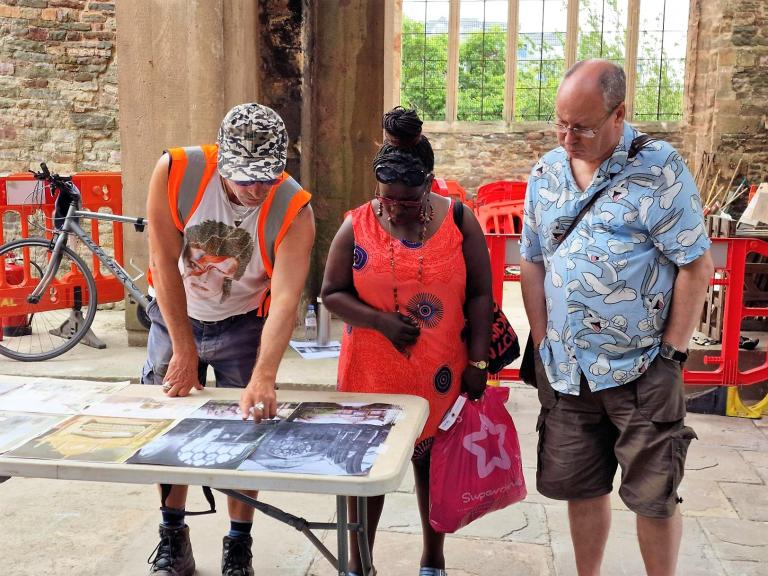
VISITORS are being invited into Wakefield Cathedral to view exciting archaeological finds including ancient tombs, medieval church walls and other signs that worship has taken place on the site for over a thousand years.
 
Archaeologists started excavation work inside the Grade 1 listed building as part of the multi-million pound redevelopment scheme, Project 2013.
 
They are removing burials from inside the nave to allow a new floor to be installed and their work has already revealed 13 burials most of which date from the 18th or 19th century but they have also found two medieval stone graves, two probable early walls and a shard of pottery, which is currently being dated.

436

Archaeological tours will run at 12.30 and 12.45pm on 25th, 28th , 30th May, 31st May, and Friday 1st June. Those booked in for 8th June will be phoned individually and offered one of the alternative dates.
 
The cathedral building is over 800 years old and dates back to the 12th century - but it is thought that there was a church on the site before that and some of the archaeological finds suggest that too.
 
The Dean of Wakefield, the Very Revd Jonathan Greener, said ‘there are some exciting finds – especially the older stone graves - as it reminds us that worship has been on this site for a thousand years and more.’
 
Andy Norton, Project Manager for Wessex Archaeology, said ‘until recently it was common for people to be buried next to or even inside churches and cathedrals. When churches were extended they could be built on top of earlier graves. The new floor for the Cathedral nave will be at a lower level than the current one and would have damaged any graves there.’
 
The Chairman of Wessex Archaeology, Robert Key, a former MP and a Lay member of the Synod of the Church of England added ‘it is important that our places of worship, which are often wonderful historic buildings are renewed for modern times.
 
But we have to respect our heritage and also make sure that no damage is done to the remains of the people who were buried here hundreds of years ago. All the burials will be carefully recorded and removed before the remains are reinterred.’
 
TO BOOK A TOUR contact Karn Dyson at the Cathedral on 01924 373923 or email: karn.dyson@wakefield-cathedral.org.uk
Project 2013 is run by Wakefield Cathedral and is supported by Heritage Lottery Fund.


437

New Fishing Industry Protocol for Archaeological Discoveries presented to Minister for Fisheries

Wessex Archaeology were invited by the Sussex Inshore Fisheries and Conservation Authority (Sussex IFCA) to attend a Ministerial meeting in Shoreham and present the newly launched Fishing Industry Protocol for Archaeological Discoveries (FIPAD).

On Monday 30th April 2012 the Rt Hon Richard Benyon MP, Minister for Fisheries, officially opened the new Sussex IFCA offices and drew attention to the new Protocol. Following a briefing about the Protocol by Dr Nikki Cook of Wessex Archaeology, the Minister was keen that the FIPAD project should be operating throughout other IFCA areas, which was very encouraging. Mr Benyon heard about the importance of the objects reported so far and saw the display and promotional materials that Wessex Archaeology has prepared.

431 Minister for Fisheries introduced to FIPAD © SIFCA

The meeting coincided with the AGM of the Sussex IFCA, and there was the opportunity to promote the FIPAD project amongst its members, including representatives from the Marine Management Organisation (MMO), sea-anglers, fishermen and local councillors. The enthusiastic support and interest in the newly launched Fishing Protocol will hopefully result in some exciting  archaeological discoveries being reported in the coming months.

The FIPAD project (www.fipad.org ) is being run by Wessex Archaeology on behalf of English Heritage and in collaboration with Sussex IFCA.

Fishing Industry Protocol for Archaeological Discoveries online now

Sussex fishermen can now report archaeological finds through the Fishing Industry Protocol for Archaeological Discoveries (FIPAD) online form.

On April 1st 2012, Wessex Archaeology launched the FIPAD on behalf of English Heritage.  Working in collaboration with the Sussex Inshore Fisheries Conservation Authority (Sussex IFCA) the Protocol is a pilot project to help fishermen report any archaeological finds they come across during their work. The aim is that the protocol will eventually run nationally.

The UK’s fishing fleets are responsible for some of the most important archaeological discoveries of the past 40 years, with anything from Palaeolithic flints to modern shipwrecks snagged or dredged up in fishing gear.

The online form is one of several hassle-free ways to report a find. You can report a find by either:

  • Clicking the Report Now button on the FIPAD website (www.fipad.org )
  • Printing out a Report Form and posting it to the “Fishing Protocol Team”
  • Telephoning 01722 326867 and ask for the “Fishing Protocol Team
  • Reporting your find directly to a FIPAD Contact at your land port. Click here for a list of FIPAD Contacts.

The FIPAD website (www.fipad.org) also offers downloadable resources, which provide information on identifying archaeological finds, how to report them and what to do with a find after its discovery. Click here to visit our Resource page.

421 Medieval carved stone statue

This stone statue, possibly medieval in date, was reported during the preliminary development of the project.  A lobster fisherman discovered it in Chichester Harbour. The statue will soon be laser-scanned by a team at Bournemouth University, which may help date and identify the piece, as there are the faint traces of lettering across the bottom of the figurine. 

The Fishing Protocol Team are at hand to deal with any reports and will make sure new discoveries are highlighted on the FIPAD website.  If you have questions or queries contact the team by email or phone.


422 423 424

English Heritage extends Contract for Archaeological Services to the Protection of Wreck Act 1973

Since spring 2003 Wessex Archaeology has delivered English Heritage’s Contract for Archaeological Services in Relation to the Protection of Wreck Act 1973.  English Heritage has  decided to extend the contract by an additional year taking our marine archaeologists back out into the field for the summer.

The principle aim of the contract is to supply advice to English Heritage, Historic Scotland, Cadw, and the Environment and Heritage Service Northern Ireland to enable them to advise their respective Secretary of State, Scottish, Welsh or Northern Ireland Ministers, as appropriate, about issues of designation and licensing under the Protection of Wreck Act1973.

419

This involves fieldwork to monitor, record and investigate designated wrecks, and assess sites that may require designation.  We are looking forward to another year of working with the heritage agencies, licensee teams and other stakeholders.

420 Wreck designated under the Protection of Wreck Act

As the team ventures out once again, we will explore some of the fieldwork undertaken last year in a series of blogs.  Keep an eye out for upcoming news to find out more.

Support the Hadrian’s Wall Fundraising Walk for the CBA

This weekend members of the CBA will start a gruelling walk along the length of Hadrian’s Wall to raise money and support for the CBA (www.britarch.co.uk).

The CBA is an educational charity working in the UK to involve people in archaeology.  The organisations activities are wide ranging and they are responsible for many great initiatives, such as the Festival of British Archaeology and Young Archaeologists Club (YAC).  The organisation acts as a voice in the interest of the UK’s heritage and does a lot of work behind the scenes to ensure the appreciation and care of the historic environment for the benefit of all.

418

Suzie Thomas (former CBA staff) and Sarah Dhanjal (YAC Branch leader) will start a ten-day walk along the entire length of the historic monument Hadrian’s wall. They will be joined in sections by Vicky Coates (YAC Membership Co-ordinator) and Mike Heyworth (CBA Director) aiming to arrive at their final destination on Tuesday the 1st of May.

The purpose of the walk is to raise money and membership for both the CBA and the YAC.  In particularly the aim is to raise enough money to ensure the continuation of the Young Archaeologist Club.  This club is a brilliant opportunity for children across the country to get hands-on opportunities to discover more about the past.  Volunteers, including staff from Wessex Archaeology, run the individual clubs. They give up their time because they believe that this is a brilliant way to encourage new generations to appreciate and look after our heritage.  The funding will among other things provide support to the volunteers to continue these activities, as well as continue the YAC magazine and website.

You can help support the CBA in the following ways

  • To donate money for the walk at their JustGiving webpage, click here.
  • To become a member of the CBA, click here.
  • To become a member of YAC, click here.

Follow Sarah and Suzie’s progress on their Facebook page.


CBA Community Archaeology Bursary placement at Wessex Archaeology

The CBA also runs the Community Archaeology Bursaries Project supported by the Heritage Lottery Fund’s Skills for the Future programme, with additional support from English Heritage, Cadw and Historic Scotland.

Wessex Archaeology recently received a bursary to employ Angus Forshaw, who will be trained as a community archaeologist, developing skills and experience in working with the public through our educational and community activities.  Keep an eye out on our blog to find out what Angus gets up to in the coming year.

Wessex Archaeology launches the Fishing Protocol for Archaeological Discoveries

On the 1st April Wessex Archaeology launched a pilot Fishing Industry Protocol for Archaeological Discoveries (FIPAD) on behalf of English Heritage.  This Protocol will allow fishermen to record archaeological finds made while fishing within the Sussex Inshore Fisheries Conservation Area (SIFCA).
    
Described by many as the “eyes and ears of the ocean”, the UK’s fishing fleets are responsible for some of the most important archaeological discoveries of the past 40 years, with anything from Palaeolithic flints to modern shipwrecks snagged or dredged up in fishing gear.


414 The wreck of HMS A1, Britain's first commissioned submarine © Crown Copyright, taken by Wessex Archaeology
These discoveries provide important information for archaeologists and help us understand Britain’s maritime heritage.

“When you look at the UK’s long and colourful maritime history and the statistics for ship losses over the years, you realise that our marine archaeological resource could potentially be enormous. We hear about new wreck sites everyday, and it is no surprise that we are getting more and more reports from fishermen about net fastenings and artefacts being brought up in fishing gear. Each new find gives us a fresh insight into our history.”

Dr. Simon Davidson, Maritime Archaeologist, WA

But it’s not all about shipwrecks, discoveries made by fishermen have revealed submerged ancient landscapes. An example is provided by oyster fisherman Michael White, who assembled nearly 300 artefacts including prehistoric flint tools while dredging in the Solent. The collection, which ranges from stone age axe heads to metal tools from the bronze age, has been described by Channel 4's Time Team archaeologist Phil Harding as “extraordinary”.

"All of these discoveries have helped us reconstruct how the landscape was used before the English Channel flooded it 10,000 years ago. If it hadn't been for Michael collecting all this material and telling us about it, we may never have encountered it – and our knowledge of the prehistoric Solent would be all the poorer."

Phil Harding, Time Team

About 400 fishing boats sail from the nine Sussex ports and so the potential for finds is high. With this in mind, the protocol is designed to make reporting a discovery as straightforward as possible.  You can report finds


Visit the FIPAD website www.fipad.org and find out more about the project.

415 416 417


Wessex artwork featured in new SeaCity Museum

435 Wessex Archaeology’s Graphics Team attended a preview for the exciting new SeaCity Museum on Wednesday.  The museum, which showcases some of the city’s unique historic collections, opens on April 10th when visitors will be able to explore three exhibitions; ‘Southampton’s Titanic Story’, ‘Southampton, Gateway to the World’ and in the special exhibition gallery, ‘Titanic the Legend’


395 Palaeolithic

396 Mesolithic

398 Neolithic


401 Bronze Age402 Iron Age

Wessex’s Senior Illustrator Karen Nichols has created five Computer Generated Images for the ‘Gateway to the World’ exhibition. The images are part of a timeline in the gallery which recounts the stories of the people who left from or arrived in the port of Southampton over the last 250,000 years.


403 At the museum


There are exciting cutting-edge, interactive, displays alongside the artefacts and a visit is thoroughly recommended. 

404 Interactive tables and moving stained glass windows!


406 Moving images

Wessex Archaeology has a long association with Southampton. The most famous of our many excavations there is the one at St Mary’s Football Stadium, where the Anglo-Saxon gold brooches (on display in the gallery) were found.. The findings were published in 2005; The Origins of Mid-Saxon Southampton by Vaughan Birbeck with Roland J. C. Smith, Phil Andrews and Nick Stoodley.

407 Anglo-Saxon brroch

Kent’s Prehistoric Pottery on Show

Wessex Archaeology’s London & South East office is hosting the Prehistoric Ceramics Research Group’s Spring Meeting.  

Join us on 28th April 2012 to hear about new discoveries and directions in the study of Kent’s prehistoric pottery.

The audience will be introduced to recent discoveries from the East Kent Access Road, one of the biggest excavations in the country over the last few years (Link) as well as from the Cliffs End, Thanet Earth and Swalecliffe projects.  Some of the Country’s leading experts will explore the pivotal role Kent played in the period.

There will be a chance to have a hands-on look at key groups of pottery from the various schemes and to hear and engage in some lively debate and catch up on current thinking. There will also be a chance to view some exciting recent Beaker and Early Bronze Age finds (around 4000 years old).
A number of Wessex Archaeology’s specialists will be taking part together with other leading specialists from the South East.
 
There will also be displays covering some of Wessex Archaeology’s recent work in Kent and a chance to buy some recent publications.
 
The event is free to both members and non-members of the group and the Prehistoric Ceramics Research Group welcomes new members.
 
Details of the day can be found at
http://www.pcrg.org.uk/index.htm

The Next Generation of Archaeologists at Wessex Archaeology

Children from a local primary school were given an introduction to archaeology at the offices of Wessex Archaeology in Rochester last week.

377

The budding young archaeologists were shown some of the work that goes on at the office including washing pottery and drawing some of the finds we get from site.
 
Some of the children were quick to grasp the idea that finds can be used to assess the status of a site!

378

In the afternoon the children were then given an introduction to some of our work in underwater archaeology and identifying some of the finds, including a cannon ball and a mammoths tooth.
 
And we shattered some illusions - archaeologists today are more likely to wear high visibility vests and hard hats than embarrassing jumpers.

379 Dressing up in high visibility clothing

The children seemed to thoroughly enjoy their day (although the most popular part were the biscuits) and we received some most welcome thank you cards. We would have been equally happy with wine though..

380

The day organised by Helen Glass of Wessex Archaeology and Wendy Rogers of Kent County Council and carried out by Katie Card one of Wessex Archaeology’s specialist learning and access officers. Please contact Helen about regarding our outreach programmes and how Wessex Archaeology can add value to a development using our experienced team of specialist learning and access officers.
 
Syndicate content